


Bright highlights, dark shadows, and vivid color can make a movie or sports broadcast feel more lifelike, but the label “HDR” doesn’t tell you everything about the picture you’ll get. What is an hdr tv? It’s a television designed to display high dynamic range content, which can carry a broader range of brightness and color information than standard dynamic range video. The result depends on the TV’s display hardware, the HDR format, the source, and the room where you watch.
That distinction matters if you’re comparing a compact television, a large living-room screen, or a Mini-LED model with local dimming. HDR support alone doesn’t guarantee intense highlights or convincing dark scenes, and manufacturer feature lists don’t provide the independent measurements needed to compare every set. The products below include televisions listing Dolby Vision, HDR10+, HDR10, or HLG, alongside a streaming device that supports HDR10+. For background on resolution, see our guide to 4K UHD picture basics, and our explanation of how Full HD TVs handle 4K sources.
Top Products

Pros
- Vibrant Quantum Dot color performance with Dolby Vision and HDR10+ support
- Exceptional motion handling with 144Hz native refresh rate and VRR for gaming
- Intuitive Fire TV ecosystem with conversational Alexa+ voice search and camera feeds
- Broad smart connectivity including 4 HDMI ports, AirPlay 2, and HomeKit support
Cons
- Standard LED backlighting lacks full-array local dimming for absolute inky blacks
- Wide viewing angles can lead to slight color fading when viewed from extreme off-center seats
- Fire TV home screen features sponsored recommendations and banner promotions
The TCL 75-Inch F8D Series represents a massive screen upgrade engineered for home theater enthusiasts, active gamers, and busy households looking for high performance without luxury price tags. Positioned as a versatile 4K QLED smart display powered by Amazon's Fire TV OS, this unit serves as a commanding centerpiece for living room watch parties, basement gaming caves, and family entertainment centers. By pairing rich Quantum Dot color with native high refresh rate hardware, TCL addresses the visual demands of sports lovers tracking fast action, movie fans streaming high-dynamic-range releases, and console players craving fluid gameplay.
Visual performance is driven by a 4K panel capable of covering 93% of the DCI-P3 color space, reproducing rich reds, subtle skin tones, and vivid scenery with remarkable vibrancy. Support for both Dolby Vision and HDR10+ ensures that viewers get optimized contrast and frame-by-frame color mapping regardless of which streaming service they frequent. The high-brightness LED backlighting teams up with an integrated ambient light sensor, adjusting the screen output to combat daytime living room glare while softening the image during late-night movie sessions. While standard LED backlighting cannot match the deep black levels of full array local dimming or OLED displays, the vibrant colors and sharp upscaling make standard HD feeds and 4K HDR movies look crisp and immersive.
Where this 75-inch television truly stands out is its motion handling and gaming suite. Built around a native 144Hz panel with Motion Rate 480 and TCL Game Accelerator 288 technology, the display eliminates motion blur during fast-paced Sunday football games and chaotic action movies. Dedicated gamers connecting a modern console or gaming PC can take advantage of Variable Refresh Rate (VRR) and Auto Low Latency Mode (ALLM). These low-lag features ensure that button inputs translate instantaneously on-screen, preventing screen tearing and stuttering during competitive online matches.
Daily navigation is powered by the Fire TV interface, offering instant access to essential streaming platforms such as Prime Video, Netflix, Disney+, and YouTube. The included Alexa+ voice integration simplifies searches across multiple apps and lets homeowners monitor smart cameras, adjust smart lighting, or control compatible smart home gear without pausing playback. Audio is handled by built-in speakers supported by Dolby Atmos and DTS Virtual:X, providing clear vocal projection for news broadcasts and sitcoms. Connecting secondary hardware is straightforward thanks to four HDMI ports, including an eARC connection for premium soundbars, alongside Bluetooth 5.4, Wi-Fi 5, and Apple AirPlay 2 support.
While the panel delivers bright, saturated visuals, viewers seated far to the sides may notice slight color washout due to standard LED viewing angle limitations. For dedicated movie lovers seeking zero haloing in pure dark rooms, an upgraded mini-LED model might be considered, but the F8D hits a sweet spot of performance and value. It remains an outstanding recommendation for families, sports fans, and gamers wanting a giant, responsive 75-inch screen that handles everyday streaming and smart home management with ease.
Console and PC gamers will find serious capability packed into this display. The native 144Hz panel ensures ultra-smooth frame rates, while Game Accelerator 288 pushes processing speeds even higher for lightning-fast competitive play.
With Auto Low Latency Mode (ALLM) and Variable Refresh Rate (VRR), the television detects when a gaming console powers on and immediately switches to an ultra-responsive profile to eliminate input lag, screen tearing, and judder during high-speed action.
The Amazon Fire TV platform organizes favorite streaming apps, live channels, and personalized recommendations onto a clear home screen. Integrated Alexa+ functionality takes hands-free voice assistance further by letting you search content naturally across platforms.
Beyond entertainment, the television doubles as an everyday command center for your connected home. View feeds from up to four smart security cameras simultaneously, dim compatible living room lights, or adjust smart thermostats right from the remote control.
Pros
- Exceptional peak brightness and local dimming control produce deep contrast in both sunny living rooms and dark home theaters.
- High-speed 165Hz native panel with Game Booster 330 gives console and PC gamers exceptionally low latency and fluid frame rates.
- Integrated 2.1.2 multi-channel audio tuned by Devialet provides richer dialogue and bass than standard flat-panel TV speakers.
- Dual-layer anti-glare screen effectively diffuses reflections from overhead lighting and bright side windows.
- Google TV smart platform with Gemini conversational search makes finding movies and live sports quick and intuitive.
Cons
- At nearly 71 pounds, the 75-inch frame requires two people and a heavy-duty wall mount or wide media console for safe installation.
- Off-angle viewing may show slight contrast reduction compared to OLED displays when sitting far to the side of the screen.
- Accessing the highest 330Hz VRR ceiling requires a dedicated high-end gaming PC setup rather than a standard home console.
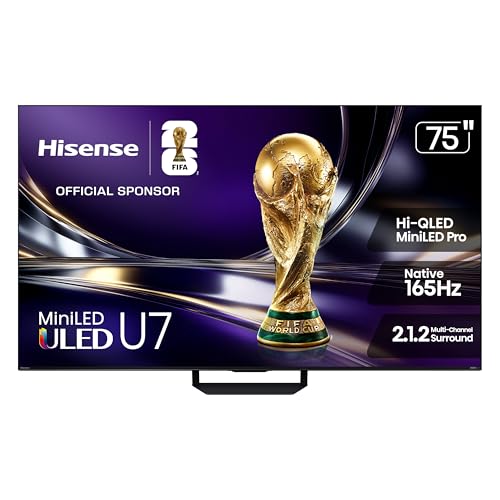
The Hisense 75-Inch U7SG Mini-LED ULED 4K Google TV represents a powerhouse display tailored for contemporary home entertainment setups. Built around an advanced Mini-LED backlight array and quantum dot color, this large-screen television bridges the gap between everyday living room viewing and high-end gaming performance. It is tailored for homeowners building a dedicated media space, apartment dwellers with expansive living areas, family households streaming cartoons and weekly blockbusters, sports fans hosting Super Bowl gatherings, and serious gamers seeking lightning-fast responsiveness on a massive canvas.
Picture performance stands out due to the combination of up to 3,000 local dimming zones and an impressive 3,000 nits of peak brightness. Based on product specifications, this dense backlight structure gives the display precise light control, rendering deep inky blacks next to brilliant HDR specular highlights without noticeable blooming. Supported by Pantone-validated Hi-QLED color, Dolby Vision IQ, HDR10+, and IMAX Enhanced decoding, cinematic films retain rich shadow detail and accurate skin tones. The inclusion of an anti-reflection, glare-free dual-layer screen treatment means afternoon sun and bright overhead fixtures will not wash out the screen during daytime viewing.
For gamers and sports fans, motion handling is where the U7SG truly shines. A native 165Hz refresh rate paired with Motion Rate 660 and the Hi-View AI Engine Pro eliminates judder, blur, and frame stutter during chaotic action sequences and rapid camera pans in football or basketball broadcasts. PC and console gamers can take advantage of Game Booster technology reaching up to 330Hz VRR, auto low latency mode (ALLM), and an on-screen Game Bar for instant monitoring of frame rates and HDR settings. The result is fluid gameplay with reduced input lag that keeps competitive players in total control.
Smart functionality and audio engineering are equally well-integrated into the overall package. Running on Google TV with built-in Gemini Interactive AI, the interface offers conversational recommendations across thousands of streaming apps such as Netflix, Disney+, Prime Video, and YouTube. Instead of basic speaker hardware, Hisense equipped this model with a 2.1.2 multi-channel surround sound system tuned by Devialet. With dedicated upward-firing channels and Dolby Atmos processing, dialogue stays intelligible while sound effects provide a convincing sense of height and spatial depth straight out of the box.
From a design standpoint, the U7SG features a slim profile, thin bezels, and a sturdy build weighing roughly 70.8 pounds. While standard VESA mount compatibility allows for clean wall installations, the physical dimensions of 65.7 inches wide by 37.9 inches high require a sizable media console if using the included tabletop stand. Setting up Google TV and connecting peripherals is straightforward, assisted by modern HDMI 2.1 connectivity with eARC support for soundbars, alongside reliable Wi-Fi and Bluetooth wireless connections.
While the display delivers outstanding brightness and contrast, potential buyers should note typical Mini-LED viewing angle limits, where colors and contrast can soften slightly when viewed from sharp side angles. Furthermore, taking full advantage of the extreme 330Hz refresh rate ceiling requires a capable gaming PC setup. For movie lovers, sports enthusiasts, and families wanting a bright, vibrant, and ultra-responsive 75-inch 4K centerpiece without paying top-tier OLED prices, the Hisense U7SG stands out as a high-value home entertainment investment.
Console and PC gamers will appreciate the native 165Hz refresh rate and Game Booster mode that scales up to 330Hz VRR. These technical capabilities help minimize screen tearing, motion blur, and controller latency during fast-paced shooters, racing titles, and sports simulations. HDMI 2.1 bandwidth allows modern consoles like the PlayStation 5 and Xbox Series X to output smooth 4K gaming with variable refresh rate and auto low latency mode engaged automatically.
The integrated Game Bar provides real-time access to vital performance stats without forcing players to pause or navigate away from the match. Gamers can quickly check current frames per second, toggle VRR status, adjust dark-field contrast to spot hidden opponents in shadows, and verify HDR output. Combined with the massive 75-inch display surface, the Hisense U7SG delivers an immersive, arena-like gaming experience for both casual weekend sessions and intense competitive tournaments.
The core visual strength of the Hisense 75U7SG stems from its Hi-QLED Mini-LED backlight system featuring up to 3,000 individual local dimming zones. By isolating illumination to tiny clusters of backlights, the screen produces deep black levels that approach OLED territory while maintaining the searing highlight intensity that only high-end Mini-LED panels can produce. With up to 3,000 nits of peak brightness, HDR highlights such as sunlight reflections, explosions, and neon signs leap off the screen.
Color reproduction benefits from Pantone validation, which helps preserve realistic skin tones, authentic foliage greens, and true-to-life team jerseys. Working behind the scenes, the Hi-View AI Engine Pro continuously analyzes incoming video frames to optimize sharpness, upscaling lower-resolution cable broadcasts and older streaming catalog titles to crisp 4K quality. Dual-layer anti-glare screen filtration further protects contrast integrity in sun-drenched living rooms.


Pros
- Brilliant 4K playback with HDR10+ compatibility enhances movie nights and sports streaming.
- Discreet plug-in design hides behind the TV without blocking adjacent HDMI ports.
- All-in-one voice remote eliminates the need to juggle separate TV power and volume remotes.
- Roku platform offers responsive navigation and a massive selection of free and premium channels.
- Simple setup makes it ideal for upgrading older smart TVs, bedroom displays, or guest room setups.
Cons
- Lacks Dolby Vision support, which some high-end 4K home theater owners might prefer.
- Requires a wall outlet adapter if your TV USB port provides insufficient power.
- Does not include an integrated Ethernet port, relying entirely on home Wi-Fi connectivity.
The Roku Streaming Stick Plus is a dedicated 4K streaming media player engineered to modernize any television setup with fast access to digital entertainment. It caters directly to cord-cutters, apartment dwellers, movie enthusiasts, and busy families who want an intuitive smart TV experience without replacing their current display. Whether you are outfitting a primary living room screen, a guest bedroom display, or a college dorm TV, this compact dongle provides a straightforward streaming upgrade.
On the video performance front, the device streams in ultra-high-definition 4K resolution and supports HDR10+ formatting. When connected to a compatible 4K TV, viewers can expect rich contrast, accurate color rendering, and sharp picture clarity during family movie nights or weekend sports streaming sessions. The HDR processing helps preserve highlight details in bright daylight scenes and prevents shadow crushing in darker dramatic films, providing a noticeable visual lift over standard 1080p streaming sticks.
At the heart of the experience is the renowned Roku operating system, which remains one of the cleanest and easiest navigation interfaces on the market. Users get access to massive libraries of on-demand content, including Netflix, Disney+, Prime Video, and Max, alongside an extensive catalog of free ad-supported live television. The included voice remote speeds up searches across multiple services, while integrated TV power and volume controls eliminate everyday remote clutter on the coffee table.
From a hardware and design perspective, the stick form factor is built for convenience and clean installations. Measuring just under four inches in length, it slips neatly into any rear or side HDMI port without obstructing adjacent inputs, making it an excellent match for tight wall-mounted TVs. Power can often be drawn directly from a standard TV USB port, which minimizes visible cords. Built-in Wi-Fi connectivity handles multi-room wireless setups, making travel between home, hotel rooms, and vacation rentals seamless.
While the device excels at general streaming tasks, there are a few practical trade-offs to keep in mind. The unit relies entirely on wireless networking, meaning users with congested Wi-Fi routers cannot plug in a direct wired Ethernet cable without third-party adapters. In addition, home theater purists seeking advanced Dolby Vision mastering will need to look to higher-tier players, as HDR support here is focused around HDR10 and HDR10+. Some older TV USB ports might also fail to deliver enough amperage, necessitating the use of a standard wall outlet.
Overall, the Roku Streaming Stick Plus represents an exceptionally practical purchase for streamers, sports fans, and families seeking dependable 4K performance at an accessible price. It transforms sluggish, outdated smart TV interfaces into responsive entertainment hubs with minimal physical footprint. For everyday living room viewing, secondary bedroom displays, or portable streaming on the go, this stick delivers strong everyday value.
The Roku OS interface provides a clutter-free, customizable home screen where your favorite streaming apps sit front and center. You can quickly launch major platforms like YouTube, Hulu, Apple TV+, and ESPN without wading through aggressive full-screen banner advertisements.
Cord-cutters benefit from deep integration with The Roku Channel, offering hundreds of free live linear channels covering local news, weather, sports commentary, and classic sitcoms. Unified subscription management also allows you to consolidate billing across various premium services into a single profile.
The included voice remote allows users to press a button and speak natural commands to launch movies, locate favorite actors, or switch genres. Furthermore, its universal power and volume buttons sync directly with your television, streamlining daily TV operation down to a single handheld controller.
Setting up the Roku Streaming Stick Plus requires just a few minutes, making it well-suited for non-technical users and quick bedroom TV upgrades. You simply plug the stick directly into an available HDMI port on the back or side of your television.
For cable management, the stick can frequently run off a 5V USB port built into your TV using the included cable, eliminating the need to drop power cords down through walls or behind furniture. If your TV does not output sufficient USB power, the stick can easily be plugged into a nearby wall outlet.
Once connected, on-screen prompts guide you through Wi-Fi network pairing, account activation, and remote calibration for TV volume and power controls. Its slim footprint keeps neighboring HDMI slots completely unobstructed for gaming consoles or soundbars.

Pros
- Vibrant QLED color volume paired with broad HDR format support including Dolby Vision and HDR10+
- Responsive gaming perks like Game Accelerator 120, low latency ALLM, and quick-access Game Bar
- Broad smart connectivity supporting Amazon Alexa, Apple AirPlay 2, and Apple HomeKit
- Lightweight 12.3-pound profile simplifies wall mounting and stand assembly
Cons
- Compact 43-inch display size may feel small in larger living rooms or dedicated home theaters
- Standard built-in television speakers benefit noticeably from an external soundbar for rich bass
- Narrower viewing angles typical of high-contrast VA-style panels compared to OLED screens
The TCL 43-Inch F7D Series QLED 4K Smart TV brings modern display technology into a versatile, compact form factor designed for practical spaces. Engineered with a Quantum Dot panel, this television targets apartment dwellers, college students, bedroom entertainment seekers, and budget-conscious shoppers who want vibrant 4K visuals without purchasing an overwhelming screen. Whether you are outfitting a dedicated gaming corner, a secondary guest bedroom, or a cozy living room, this television provides a balanced combination of rich color reproduction and connected smart capabilities.
Picture performance is anchored by TCL's Quantum Dot color system, which reproduces over one billion shades for lifelike depth and vivid realism. Support for HDR PRO+ means the panel can interpret multiple dynamic range standards, including Dolby Vision, HDR10+, standard HDR10, and HLG. This comprehensive HDR compliance helps pull out crisp specular highlights and deeper shadows during late-night movie sessions. Additionally, 4K upscaling ensures older broadcasts, standard cable feeds, and classic streaming movies retain solid sharpness and detail.
Fast-moving content benefits from Motion Rate 240 processing along with MEMC motion smoothing, which actively reduces motion blur during Sunday football games, high-speed racing, and chaotic blockbuster action sequences. Gamers will particularly appreciate the inclusion of Game Accelerator 120 alongside Auto Game Mode (ALLM). By automatically reducing input latency when a console is detected, the display maintains swift responsiveness, while the integrated Game Bar overlay lets players fine-tune crosshairs, refresh status, and picture settings on the fly.
Everyday usability remains straightforward thanks to broad smart home platform support. The bundled voice remote provides quick access to Amazon Alexa, letting viewers search for content, launch streaming apps, or manage connected smart home devices like lights and thermostats from the couch. Apple ecosystem users also gain Apple AirPlay 2 and Apple HomeKit support, making it simple to beam family photos, workout streams, or videos directly from an iPhone, iPad, or Mac.
Practicality shines in the hardware design, with a lightweight build of just 12.3 pounds that makes moving and mounting the set relatively painless. VESA mount compatibility allows easy wall installation, while the included stand feet fit neatly onto smaller dressers or entertainment desks. On the audio side, onboard support for Dolby Atmos and DTS:X ensures compatibility with multi-channel audio feeds, though pairing the unit with an external soundbar via HDMI eARC is recommended for deep, theater-style bass. Viewing angles remain best from head-on positions, as typical with high-contrast LED panels.
For shoppers looking to balance display quality, responsive gaming tools, and compact utility, the TCL 43F7D stands out as a sensible, feature-rich choice. It delivers strong value for console gamers, dorm room setups, and family streaming spaces where a reliable, vibrant 4K display is required without dominating the entire room.
Console players and PC gamers looking for a secondary display will find several performance-oriented features packed into this 43-inch screen. The Game Accelerator 120 feature works in tandem with TCL's processing to boost refresh capabilities, providing a visibly smoother experience during high-intensity gameplay.
Auto Game Mode (ALLM) automatically detects connected gaming consoles like the PlayStation 5, Xbox Series X, or Nintendo Switch, immediately switching the display to low-latency mode to reduce control lag. The integrated Game Bar overlay allows quick adjustments to display ratios, frame rate monitoring, and screen presets without having to exit to the main television menu.
Smart platform versatility is a major highlight, avoiding ecosystem lock-in by integrating Amazon Alexa alongside Apple AirPlay 2 and Apple HomeKit. Users can manage connected lights, view smart camera feeds, and cast multimedia straight from iOS or Android devices with minimal configuration.
Audio decoding covers both major spatial audio standards: Dolby Atmos and DTS:X. While the internal stereo speakers handle everyday dialogue and news clearly, the presence of HDMI eARC ensures uncompressed multi-channel pass-through to compatible soundbars and home theater receivers.

Pros
- Excellent brightness and contrast from Mini-LED backlighting, great for well-lit rooms and HDR content.
- High native 144Hz refresh rate with support for VRR and ALLM makes it a strong gaming TV for consoles and PC.
- Google TV interface is snappy, intuitive, and offers a wide selection of streaming apps.
- Dolby Atmos and Onkyo audio provide solid built-in sound quality, reducing need for a soundbar.
- Competitive pricing for a Mini-LED QLED with these features, offering strong value for budget-conscious shoppers.
Cons
- Viewing angles may be limited compared to OLED, with potential color shift when viewed from the side.
- Built-in speakers, while decent, may lack deep bass for home theater enthusiasts used to external audio systems.
- As a new 2025 model, there are minimal user reviews available to confirm long-term reliability and performance consistency.
The TCL 55-inch QM6K is a 2025 model Mini-LED QLED 4K TV that aims to deliver premium performance without the premium price tag. It combines TCL's Mini-LED backlight technology with Quantum Dot color to produce impressive brightness, deep blacks, and vibrant, accurate colors. This television is designed for a wide range of viewers including homeowners looking to upgrade their living room, apartment renters wanting a space-efficient yet powerful TV, gamers who demand smooth motion and low input lag, sports fans who want crystal-clear action, movie lovers craving HDR excellence, families needing a versatile daily driver, cord-cutters and streamers who live in streaming apps, and budget-conscious shoppers seeking high value. The QM6K also suits tech enthusiasts curious about Mini-LED, and it could work as a bedroom TV or even for outdoor entertainment in a covered patio.
Picture quality is the highlight here. The Mini-LED array provides excellent local dimming control, which enhances contrast and black levels far beyond standard LED TVs. The Halo Control System aims to reduce blooming and halo effects, so dark scenes remain deep while bright highlights stay sharp. Color volume is outstanding thanks to Quantum Dots, covering over a billion shades. HDR performance is strong with support for Dolby Vision, HDR10+, HDR10, and HLG, ensuring compatibility with all major HDR sources. Brightness is high enough to combat glare in moderately lit rooms, making it practical for daytime viewing. Motion handling is superb with a native 144Hz refresh rate and a motion rate of 480, reducing blur in fast-paced sports, action movies, and video games. Some users may notice slight judder in 24p content, but motion interpolation can smooth that out if preferred.
For gaming, the QM6K is a standout. The 144Hz native refresh rate, combined with Variable Refresh Rate (VRR) and Auto Low Latency Mode (ALLM), ensures tear-free, responsive gameplay. Input lag is very low, making it suitable for competitive gaming on consoles or PC. While the product listing doesn't specify HDMI 2.1 ports, the high refresh rate and VRR support suggest it has at least one HDMI 2.1 port to handle 4K at 144Hz. This TV will work well with PlayStation 5, Xbox Series X, and high-end gaming PCs. The Google TV platform is responsive and easy to navigate, with quick app loading and a personalized home screen. Voice control via Alexa or Google Assistant works reliably for searching content, controlling smart home devices, and adjusting settings.
Sound quality is better than many built-in TV speakers thanks to the Onkyo-tuned system and Dolby Atmos support. Dialogue is clear, and there's enough bass for casual viewing without a soundbar. However, audiophiles or home theater purists may still want to add an external sound system for fuller, more immersive audio. The design is modern with slim bezels, a sturdy central stand, and a clean profile that fits well in most entertainment centers. VESA mount compatibility makes wall mounting easy, and the included voice remote is comfortable to use with dedicated streaming buttons. Setup is straightforward, and the TV automatically detects devices connected via HDMI. Wi-Fi and Bluetooth connectivity are reliable for streaming and pairing accessories.
There are a few realistic limitations to consider. Viewing angles are typical for a VA-based panel, so color and contrast degrade when you sit far to the side. This TV is best enjoyed directly in front. Also, while the built-in speakers are decent, they cannot match the depth of a dedicated soundbar or surround system. As a brand-new 2025 model, user reviews are scarce, so long-term reliability is not yet proven. Potential buyers might want to check for any early adopter issues. Overall, the TCL 55-inch QM6K offers an appealing package of Mini-LED picture quality, high refresh rate gaming, and a smart platform, all at a price that undercuts many competitors. It's an excellent choice for anyone who wants a premium viewing experience for movies, sports, and gaming without breaking the bank.
The TCL QM6K uses a Mini-LED backlight combined with Quantum Dot technology to deliver exceptional brightness and a wide color gamut. The local dimming system, called Halo Control, helps reduce blooming and improve black levels, resulting in deeper shadows and more precise highlights. In HDR mode, the TV can get impressively bright, making Dolby Vision and HDR10+ content look vibrant and lifelike. Color accuracy is good out of the box, with over a billion colors supported. Motion is handled well thanks to the 144Hz panel and motion smoothing options, though purists may want to disable interpolation for film content. Overall, the picture quality punches above its price point and competes well with more expensive models.
Gamers will appreciate the 144Hz native refresh rate, which ensures smooth motion and reduced blur in fast-paced titles. VRR and ALLM support minimize screen tearing and input lag, providing a responsive experience for competitive gaming. While the product does not explicitly list HDMI 2.1, the 144Hz capability at 4K suggests it has the necessary bandwidth. Input lag is very low, making it suitable for first-person shooters and racing games. The QM6K is a solid choice for PlayStation 5, Xbox Series X, and PC gaming. The Google TV interface also offers gaming-related apps and cloud streaming services.
The TV runs Google TV, which provides a clean, customizable home screen with recommendations based on your viewing habits. It includes access to thousands of apps like Netflix, Prime Video, Disney+, YouTube, and more. Voice control is built-in with Google Assistant and Alexa, allowing you to search for shows, control smart home devices, and adjust settings hands-free. The interface is responsive and fast, with quick app loading times. Chromecast is integrated, so you can cast content from your phone. The remote has dedicated buttons for popular streaming services and a voice control button.
The TCL QM6K features a speaker system tuned by Onkyo, which is a step above typical TV audio. It supports Dolby Atmos, giving a sense of height and immersion. Dialogue is clear, and there is modest bass for a built-in system. For everyday TV watching, news, and casual streaming, the sound is more than adequate. However, for a true home theater experience or bass-heavy content like action movies, adding a soundbar or external speakers will enhance the soundstage and depth. The TV also has an eARC HDMI port to easily connect an audio system.

Pros
- Excellent value for a budget 40-inch smart TV with HDR and free streaming content.
- Lightweight (13 lbs) and slim design make it easy to wall-mount or place on a stand.
- Object Tracking Sound Lite provides a surprisingly immersive audio experience for a budget TV.
- Samsung's Tizen platform is responsive and loaded with popular streaming apps like Netflix, YouTube, and Prime Video.
- Knox Security offers peace of mind against phishing and unauthorized access to your smart home.
Cons
- Only 1080p resolution, so it may not satisfy those seeking 4K ultra-HD clarity for larger screens or home theater setups.
- Brightness and HDR performance are limited compared to higher-end models, especially in well-lit rooms.
- No Dolby Vision support, and color volume is adequate but not exceptional for serious movie enthusiasts.
The Samsung 40-inch F6000 Smart TV (2025 Model) is a Full HD (1080p) television designed for casual viewing, streaming, and everyday entertainment. It strikes a practical balance between affordability and essential smart features, making it a strong contender for bedrooms, apartments, dorm rooms, or secondary living spaces where a larger 4K TV would be overkill.
This TV shines for budget-conscious shoppers, cord-cutters, and families who want a simple, reliable smart TV without breaking the bank. With Samsung's Tizen OS and One UI interface, you get quick access to popular streaming apps like Netflix, Hulu, Disney+, and Prime Video. Plus, the inclusion of Samsung TV Plus (2,700+ free channels) means you can enjoy live news, sports, movies, and kids' shows without any subscription fees.
Picture quality is solid for the price point. The Full HD panel with HDR support, PurColor, and Mega Contrast technology delivers decent contrast and vibrant colors. While it can't match the deep blacks or peak brightness of a 4K QLED or OLED, it performs well in moderately lit rooms. Motion handling is adequate for casual sports and fast-paced content, though serious gamers or home theater purists may want a higher refresh rate and 4K resolution.
Sound is a pleasant surprise. Object Tracking Sound Lite creates a virtual surround effect that follows on-screen action, making movies and games feel more engaging. Pairing with a compatible Samsung soundbar via Q Symphony further enhances audio quality, allowing both the TV and soundbar speakers to work together seamlessly. The slim 3-bezel-less design looks modern and fits easily on most TV stands or wall mounts (VESA compatible).
Connectivity includes standard ports, but note this model likely lacks HDMI 2.1 or high-refresh-rate gaming features. It's fine for casual console gaming (Nintendo Switch, older PS4/Xbox One) but not ideal for competitive 120fps gaming. Setup is straightforward, and the included remote is intuitive. One standout feature is Samsung Knox Security, which adds protection against phishing and virus threats for connected smart home devices.
Overall, the Samsung 40-inch F6000 is a practical choice for anyone seeking an affordable, no-fuss smart TV for daily streaming, news, and family shows. It's not meant for ultra-bright rooms or cinephiles craving Dolby Vision, but for its price and size, it delivers a satisfying viewing experience. If you need a reliable second TV for a bedroom or a cost-effective main TV for an apartment, this model is well worth considering.

Pros
- Mini-LED local dimming and quantum dot color provide impressive contrast and HDR highlights for the screen size
- Native 144Hz panel offers smooth performance for competitive gaming and high-speed sports broadcasts
- Anti-glare screen coating effectively curbs reflections from windows and household lighting
- Built-in subwoofer adds satisfying low-end presence compared to standard flat-panel speakers
- Unibody slim design with narrow bezels maximizes display area for a clean living room aesthetic
Cons
- Large 85-inch profile weighing over 68 pounds requires a wide media console or a heavy-duty wall mount with two-person installation
- Off-angle viewing can show slight color and contrast fading compared to viewing directly centered
- Fire TV home interface includes sponsored banners and promotional content
The Hisense 85-Inch U6 Pro Series (85U6SF Pro) is an extra-large 4K smart television designed to deliver an authentic home cinema and gaming hub in modern living spaces. Equipped with Mini-LED backlighting, Hi-QLED quantum dot color, and a native 144Hz panel, this display addresses the demand for high-end picture performance on an imposing screen. It is tailored for homeowners building a dedicated basement media room, sports fans hosting game-day gatherings, passionate console and PC gamers, and movie buffs seeking cinematic immersion without paying flagship OLED prices.
Visual performance stands out thanks to the combination of Mini-LED local dimming and quantum dot color reproduction. Hundreds of compact light zones allow the panel to produce deep black levels and punchy highlights with reduced blooming around subtitles and bright objects. Support for Dolby Vision IQ and HDR10+ Adaptive enables the screen to adjust its output in response to your room's ambient lighting, preserving shadow detail whether you are streaming a dark thriller at night or watching morning news. The anti-reflection, glare-free coating is particularly beneficial for sun-drenched family rooms, keeping washed-out reflections to a minimum.
Gamers and sports lovers will appreciate the native 144Hz refresh rate paired with Motion Rate 480 processing. High-speed football passes, hockey puck tracking, and rapid camera pans remain sharp without distracting motion judder. For console and PC enthusiasts, the elevated refresh rate and fast panel response help minimize input lag and screen tearing during intense multiplayer tournaments. The onboard Hi-View AI Engine works continuously behind the scenes, applying real-time enhancements to lower-resolution broadcasts, live sports streams, and older video games for crisper edge definition and balanced saturation.
Audio and smart features are practical and user-friendly. Unlike many thin displays that produce tinny audio, the U6 Pro integrates a dedicated built-in subwoofer alongside Dolby Atmos and IMAX Enhanced audio support. This hardware configuration provides notable depth to rumbling explosions, musical scores, and commentary dialogue. Running on Amazon's Fire TV platform, the television offers straightforward access to major platforms including Prime Video, Netflix, Disney+, and YouTube, while the included Alexa+ voice remote lets you quickly launch shows, change inputs, or control smart home devices.
With an expansive footprint measuring over 74 inches wide and weighing approximately 68 pounds, setup is a project best handled by two adults. The unibody slim aesthetic and slim bezels give the panel a contemporary profile whether anchored on a wide entertainment stand or mounted to the wall via standard VESA brackets. As with many high-contrast VA-type panels, optimal contrast and color saturation are enjoyed from directly in front of the screen, as wider viewing angles from the far edges of a room can lead to slight contrast rolloff. For families and home entertainment lovers looking to transform their living room into a true entertainment center, the Hisense 85U6SF Pro offers an impressive balance of scale, speed, and contrast.
Gaming on an 85-inch screen can be overwhelming if motion handling falls short, but the Hisense U6 Pro addresses this with a native 144Hz panel. Fast action games, first-person shooters, and racing simulations benefit from crisp frame transitions and reduced motion blur. The high refresh rate ensures PC gamers can push higher frame rates, while next-generation consoles take full advantage of smooth variable refresh performance.
Low input latency helps controller inputs translate onto the screen without noticeable delay, which is critical during fast-paced competitive rounds. Combined with rich HDR contrast and vibrant Hi-QLED color tuning, game environments look vivid and detailed, whether you are exploring dimly lit caves or driving across sunlit open worlds.
A true theater setup requires both visual punch and respectable audio, and the U6 Pro is built to deliver on both fronts. The combination of Mini-LED local dimming, Dolby Vision IQ, and IMAX Enhanced certification ensures that 4K movies retain their intended cinematic contrast, deep shadows, and luminous highlights without washing out your living space.
The inclusion of a built-in subwoofer adds physical low-frequency punch that standard integrated speakers rarely match. Movie scores, action scenes, and stadium crowd roars carry authentic weight. While serious audiophiles will still prefer a multi-channel soundbar or AV receiver setup via eARC, the factory speaker array provides impressive baseline sound for daily streaming and family movie nights.
HDR Explained: Formats, Screens, and What to Expect
HDR, short for high dynamic range, is a way of encoding video with a wider range of brightness and color information than standard dynamic range, or SDR. An HDR-compatible television can interpret that information and use its display hardware to present brighter highlights, more nuanced tones, or richer color when the content and TV support them. The label describes a capability, not a guaranteed picture quality level. A basic HDR television and a higher-performing Mini-LED television may both recognize an HDR signal while producing noticeably different results.
HDR is a signal format and a display capability
HDR begins with content mastered and delivered in an HDR format. A compatible streaming app, disc player, game console, or other source sends that signal to the television, which then maps the content’s brightness and color information to what its screen can show. If the source, connection, or TV doesn’t support the same format, playback may use another available format or standard dynamic range instead. Compatibility therefore involves the whole viewing chain, not just a logo on the television’s packaging.
HDR10 is a widely used format, while Dolby Vision and HDR10+ can carry scene-by-scene or frame-by-frame metadata to guide how a TV maps the image. HLG is another HDR format, commonly associated with broadcast applications. These formats do not create more light from a screen than its hardware can produce. They provide instructions and image information; the TV still has to render it within its own brightness, contrast, and color capabilities.
Format labels can be useful when they match the services and devices you use. The supplied product information lists Dolby Vision, HDR10+, HDR10, and HLG support for the TCL 75-Inch F8D Series, while the TCL 43-Inch F7D Series lists those same formats under HDR PRO+. The TCL 98 Inch M9LF Series lists HDR10 and Dolby Vision. Those differences illustrate why buyers should check the exact model’s format list rather than assuming that all televisions from one brand support the same HDR standards.
Why brightness and local dimming influence HDR
A screen needs sufficient brightness range to make HDR highlights stand apart from the rest of the image. It also needs to preserve detail in darker areas rather than lifting shadows until the picture looks gray. The product data supplied for these options does not include independent peak-brightness measurements, so format support alone cannot establish which television produces the brightest HDR picture. Treat claims such as “high brightness” as product-description language unless reliable measurements for the exact model are available.
Backlight design affects how an LED LCD television controls light. Mini-LED sets use small backlight elements, and models with local dimming can adjust areas of the backlight separately to shape contrast across the image. The TCL QM6K is listed as a QD-Mini LED television with local dimming, while the TCL 98 Inch M9LF lists Mini LED with local dimming. Those descriptions signal a more controllable backlight design than a television listing only a basic LED backlight, but they don’t establish exact zone counts or prove that blooming is absent.
Blooming is a visible glow that can appear around bright objects against dark backgrounds when the backlight illuminates a larger area than the object itself. White subtitles, stars, or a bright logo on a dark scene may make it easier to notice. Local dimming may help control this effect, but results depend on the implementation, picture settings, and scene. A buyer who watches films in a dim room may want to consider how local dimming is implemented, while also recognizing that a product feature list cannot predict every scene’s appearance.
Quantum dot, or QLED, is a color-enhancement technology used in some LCD televisions. It doesn’t mean the screen is self-emissive, and the term alone doesn’t establish a particular contrast level or HDR brightness. Several listed products combine QLED with Mini-LED, including the Hisense U7 and the TCL QM6K. Their listed combination of technologies is relevant to HDR, but a comparison of actual picture performance would require trustworthy measurements and viewing conditions that aren’t provided here.
Room light changes how HDR looks
Sunlight and bright lamps can make a dark image look washed out and create distracting reflections. A television described as high brightness or anti-reflection may be worth considering for a brighter room, but the supplied specifications do not give measured brightness or reflection performance for a controlled comparison. The Hisense 75-inch U7 and 85-inch U6 Pro descriptions list anti-reflection or glare-reducing features; those claims indicate intended use, not immunity to glare. Screen placement and the direction of windows still matter.
Room conditions also affect which compromises are noticeable. In a darker room, a viewer may pay closer attention to shadow detail, black bars, and blooming around subtitles. In daylight, reflections and overall screen visibility may take priority. If seating extends across a wide sofa, check the specific model’s viewing-angle information where available, because the product data here does not identify panel types or provide off-axis measurements for most options.
Screen size should suit both the room and the distance from which you watch. A 43-inch model may suit a bedroom or smaller space, while a 75-inch or 98-inch screen needs more wall or stand space and may dominate a compact room. There’s no single viewing distance that works for everyone: visual preference, content resolution, and room layout all influence the choice. Before buying an extra-large television, confirm that it can be positioned safely and that its intended placement works with your room; follow the manufacturer’s handling guidance and get appropriate assistance with heavy displays.
For an outdoor or sun-exposed setup, don’t assume that an ordinary indoor television is weatherproof just because its screen is described as bright or anti-glare. Consider exposure and the manufacturer’s instructions for the particular model. Our outdoor TV guidance for bright viewing areas covers the separate suitability questions that arise when a screen will be used outside.
Native refresh rate, motion labels, and HDR gaming
Refresh rate describes how often a display can update its image, while motion-rate labels may combine processing techniques or other marketing descriptions. The distinction matters for fast-moving sports and games, but a higher refresh rate doesn’t make every HDR scene brighter or more detailed. The TCL 75-Inch F8D listing specifies a native 144Hz refresh rate, and the Hisense 75-inch U7 lists native 165Hz. The Samsung 40-inch F6000 product information mentions HDR but does not provide a native refresh-rate figure, so don’t infer one from the HDR label.
Some listings also describe VRR, ALLM, or gaming accelerators. VRR can coordinate a compatible display and game source to vary refresh timing, while ALLM can signal a switch to a lower-latency picture mode. These features are separate from HDR format decoding. The TCL F8D listing includes VRR and ALLM, and the Hisense U7 description lists VRR and a Game Booster. Check the exact input and source-device requirements before treating these features as available in every signal mode.
Don’t assume the available product descriptions establish HDMI bandwidth, the number of full-featured ports, or support for every combination of high refresh rate, resolution, HDR, and VRR. Those details can vary by input. A console or PC buyer should check the manufacturer’s specifications for the particular model and port, then confirm the connected source is set to an output the television supports. A television’s marketing refresh-rate figure by itself is not proof that every connected device can use that rate.
Motion processing can also change the appearance of films and sports. Frame interpolation may make movement look smoother, though some viewers dislike the overly fluid look it can give films. A native high-refresh-rate panel and a feature labeled Motion Rate are not interchangeable descriptions. The TCL F7D lists Motion Rate 240, while its supplied description does not identify a native panel refresh rate. Buyers should distinguish the two rather than treating a motion label as a confirmed hardware specification.
Smart devices, content sources, and format matching
A smart TV’s built-in apps can deliver streaming HDR without a separate player, but HDR availability depends on the service, title, subscription, app, and television. A “4K” label alone doesn’t confirm HDR, and an HDR-capable television won’t turn SDR material into native HDR content. Check the title’s playback details and the app’s signal information when available. If the display reports SDR for a program expected to be HDR, verify the source and app settings before assuming the panel is at fault.
The listed platforms include Fire TV on several TCL and Hisense models and Tizen on the Samsung F6000. The Roku Streaming Stick Plus is a separate streaming device, not a television, and its listing specifies 4K and HDR10+ streaming. It can add Roku’s interface to a compatible television, but it does not upgrade the TV’s panel or make the TV compatible with every HDR format. Review both the device’s output capabilities and the television’s supported inputs and formats when adding an external streamer.
Internet connection quality matters because streaming services may adjust video quality when the connection is unstable, but the product information here does not provide comparable network measurements. A television’s operating system also affects which apps and features are available, not the physical capabilities of its screen. If an HDR program looks inconsistent, compare another title or source before blaming the display. That simple check can help separate a content or app issue from a television setting or compatibility limitation.
How to judge an HDR label before buying
Start with the formats you actually use, then check the model’s exact supported list. If your streaming service or player relies on Dolby Vision, a set that lists Dolby Vision may be a closer format match than one whose specifications list only HDR10. HDR10+ matters in a similar way when your content source uses that format. Support doesn’t guarantee that every title is available in that format or that the TV will render it identically to another model.
Next, look beyond format badges to the hardware details that shape the picture. Local dimming, backlight type, and any independently measured brightness and contrast data are more informative than a generic “HDR” claim. For gaming, confirm the native refresh rate and the required features and port behavior for your console or PC. For daytime use, investigate reflection handling and brightness measurements rather than relying only on marketing terms.
Match the screen size to your space instead of choosing only by the biggest diagonal. A large display can make detail easier to see from farther away, but it also needs appropriate placement and viewing distance. A compact television may be more practical for a bedroom even if a larger set offers more advanced backlighting. The available product descriptions cover sizes from 40 inches to 98 inches, but they do not include all the room measurements needed to determine an ideal fit for a particular home.
Compare full specifications for the exact model year as well. Similar model names can have different format support, refresh rates, or smart platforms, and a product listing may use promotional terms alongside hardware specifications. Separate stated facts, such as a listed native refresh rate, from broad performance claims that lack measurements. If the information you need is missing, check the manufacturer’s model-specific documentation rather than filling the gap with assumptions.
What HDR can and cannot promise
HDR can provide a more expressive image when the content, source, format, and television work together. It cannot guarantee bright highlights, dark blacks, accurate color, or freedom from blooming on every television. The screen’s backlight and processing set practical limits, and viewing conditions influence what reaches your eyes. A format badge is a useful compatibility clue, not a complete picture-quality score.
The product list illustrates that distinction: some options identify multiple HDR formats, some combine QLED with Mini-LED, and one compact Samsung model lists HDR without a detailed format breakdown in the supplied information. The Roku device offers HDR10+ streaming but is not itself a television screen. These are different kinds of product capabilities, so compare TVs with TVs and streaming devices with the display they will feed.
For a practical decision, prioritize the HDR formats your content uses, then assess the display technology, room lighting, native refresh rate, and available gaming features that matter to your setup. Seek model-specific measurements when brightness or contrast is central to the purchase, because the supplied descriptions do not establish those results. That approach makes HDR support meaningful without mistaking a compatibility label for a guarantee of picture performance.




Write Your Review
No reviews yet. Be the first to share your experience!