


Distracting motion blur and washed-out colors can ruin a live broadcast feed sent across a local television network. Professional camera operators and video producers require uncompressed signal integrity before feeding content into multi-room TV systems or streaming platforms. Selecting a dedicated sdi to iptv encoder bridges the gap between high-end SDI production gear and IP-based smart televisions or network media players. Whether distributing clean 1080p feeds to sports bar screens or routing digital signage across hotel TVs, modern hardware encoders convert uncompressed serial digital interface video into reliable RTSP, RTMP, or UDP multicast streams. Exploring how higher resolutions operate across modern panels is straightforward when understanding what UHD means on a display, especially as 4K encoding devices enter network workflows.
Hardware encoding relieves local networks of dropped frames while maintaining crisp detail, accurate color saturation, and sharp contrast across connected displays. Standalone units like the URayCoder HEVC H.265 H.264 SD HD 3G SDI to IP and TBS TBS2602 NDI|HX2 SDI Video Encoder HTTP HLS process H.264 or H.265 video without requiring bulky desktop capture rigs. Low-latency transmission ensures live sports, worship services, and conference presentations hit remote screens without jarring audio delays or visual stutter. Evaluating port options, protocol flexibility, and compression efficiency ensures your television distribution remains rock-solid for every broadcast.

Pros
- Multi-protocol capability broadcasting up to 4 independent streams simultaneously (SRT, RTSP, RTMP, HLS, UDP)
- Efficient H.265 HEVC and H.264 video compression for optimal bandwidth management across home and commercial networks
- Customizable on-screen display (OSD) options for logos, scrolling banners, and timestamp overlays
- Compact 1.1-pound metal chassis fits easily behind display setups, inside AV racks, or on equipment shelves
- Includes developer API, SDK, CGI control documentation, and manufacturer lifetime technical support
Cons
- Features a 3G-SDI input only, requiring an external converter if capturing video directly from standard HDMI-only sources
- Does not include an integrated display panel, functioning strictly as network encoding hardware that requires an external television or monitor for playback
- Requires familiarization with IP networking and web-based control interfaces for initial setup and protocol routing
Unlike an integrated consumer television with a built-in display panel, the URayCoder 3G-SDI to IP Live Streaming Encoder belongs to the category of dedicated television broadcast and video distribution hardware. Designed to bridge professional video equipment with local area networks and online streaming ecosystems, this device encodes live SDI feeds into versatile IP-based digital streams. It is tailored for content creators, event coordinators, church media teams, sports tournament organizers, and AV integrators who need to route high-definition camera footage, live sports broadcasts, or video feeds directly to smart TVs, digital signage displays, and online streaming destinations.
When evaluating video performance, this unit processes standard-definition, HD, and 3G-SDI video feeds using advanced H.265 (HEVC) and H.264 compression algorithms. Because it operates as an encoder rather than a direct-lit or Mini-LED television display, attributes such as peak nit brightness, panel contrast, and local dimming are determined by the external smart TV, monitor, or decoder receiving the decoded signal. The encoder plays a vital role in preserving source clarity, minimizing compression artifacts, and ensuring fluid motion for fast-moving sports and live presentations by allowing full control over encoding bitrates, output resolutions, and framerates.
For streaming infrastructure and video routing, the device stands out by supporting up to four simultaneous video stream outputs across varying network protocols. Broadcasters can transmit to dedicated platforms like YouTube, Facebook, and Twitch via RTMP or RTMPS while concurrently multicasting via UDP or RTSP to networked smart TVs and IPTV decoders within a local facility. The inclusion of SRT (Secure Reliable Transport) helps maintain video stream integrity and low latency even across unpredictable or public internet connections, making it well-suited for live sports and interactive productions where signal delays must be kept to a minimum.
From a physical design and everyday management standpoint, the encoder features a compact desktop footprint measuring 6.69 by 5.12 by 1.18 inches and weighing approximately 1.1 pounds. The two-tone black and silver enclosure fits neatly onto an AV gear shelf, a camera cart, or behind commercial display mounts. Configuration is handled through a built-in web control interface where users can customize video parameters, rotate or mirror images, and apply static or scrolling text overlays, logos, and timecodes for broadcast branding. Additionally, developers can leverage provided SDK, API, and CGI control documentation for automated room-control integration.
There are a few realistic limitations to keep in mind before purchasing. Because the unit is equipped specifically with a 3G-SDI input, connecting HDMI-only devices like consumer gaming consoles or standard laptops requires an active HDMI-to-SDI signal converter. Furthermore, initial configuration requires a fundamental understanding of network IP addresses, subnets, and streaming URL syntax, which may involve a brief learning curve for non-technical users. Finally, as a dedicated encoder, it requires compatible receiving displays, media players, or software applications capable of decoding its IP network streams.
Overall, the URayCoder 3G-SDI to IP Encoder represents a capable and practical piece of television distribution hardware for users seeking reliable multi-protocol streaming without the expense of full-sized rackmount broadcast servers. With its dual H.265/H.264 compression engine, simultaneous multi-stream outputs, and robust protocol versatility, it offers excellent utility for feeding live video to displays throughout a facility or broadcasting directly to global audiences.
The URayCoder encoder provides exceptional protocol flexibility, accommodating modern network delivery workflows with ease. Operators can deploy up to four distinct output streams concurrently, each assigned its own destination and protocol such as HTTP, RTSP, RTMP, RTMPS, SRT, HLS (M3U8), UDP, RTP, Multicast, or Unicast.
This multi-protocol architecture allows a single 3G-SDI camera feed to simultaneously broadcast to public streaming platforms like Twitch and YouTube while distributing a low-latency multicast feed to local smart TVs, digital signage panels, or IPTV set-top boxes across a corporate or stadium local area network.
Featuring a slim, unobtrusive design, the unit measures 6.69 inches wide by 5.12 inches deep and just 1.18 inches tall, tipping the scale at just over one pound. The rugged metal housing provides passive heat dissipation for continuous live broadcast operation.
Its compact profile makes it an effortless addition to television media consoles, production fly-packs, mobile broadcast vans, and equipment racks. The device also includes manufacturer lifetime technical support alongside open API and CGI documentation for seamless integration into custom video control setups.

Pros
- Hardware H.265 and H.264 encoding delivers efficient 4K transmission with low network latency
- Capable of pushing up to four simultaneous streams across varied network protocols like SRT and RTSP
- Supports fluid 120fps video transmission when operating at 2K and 1080p resolutions
- Compact, lightweight 1-pound footprint tucks easily into AV cabinets and media setups
- Backed by manufacturer-listed lifetime free warranty and technical support
Cons
- 4K resolution throughput is capped at a maximum of 30fps rather than 60fps or 120fps
- Hardware HDCP decryption is limited to version 1.4, which restricts compatibility with HDCP 2.2 copy-protected 4K media
- Requires an external display, television, or networked decoder client as it is dedicated encoder hardware without a built-in screen
In the television display hardware ecosystem, the URayCoder Multi-Channel 4K Video Encoder represents a specialized video transmission and IP network streaming hardware unit rather than a standalone integrated consumer television panel. Designed for home theater builders, commercial video distribution systems, multi-screen sports bars, and live broadcast setups feeding smart TVs, this compact 1-pound hardware device bridges professional HDMI and SDI video sources into high-efficiency H.265 and H.264 streams across local IP networks. It suits video enthusiasts, sports streamers, and advanced home theater setups looking to distribute ultra-high-definition video to multiple connected televisions, displays, and online platforms without relying on bulky PC capture rigs.
When routing video to 4K UHD displays, the encoder supports native 3840x2160 input and output resolutions powered by its dual H.265 and H.264 hardware encoding chip. At full 4K UHD resolution, output transmission is capped at a maximum of 30 frames per second, which delivers steady, artifact-resistant playback for cinematic movies, corporate feeds, and broadcast streams sent to 4K televisions. For users routing high-motion gaming or fast-action sports content, lowering the resolution to 2K (1440p) or 1080p unlocks high-frame-rate throughput up to 120fps. This provides fluid motion handling on compatible 120Hz televisions and gaming monitors, preventing the jitter often associated with software-based encoding.
For console gamers and live video setups, the unit incorporates hardware HDCP 1.4 decryption to streamline HDMI ultra HD source pass-through and decoding. The hardware is equipped with an Ethernet network interface that facilitates low-latency transmission across local area networks via protocols like SRT, RTSP, RTMP, and UDP Multicast. On the audio side, it handles both HDMI embedded digital audio and dedicated 3.5mm line-in audio inputs with adjustable audio parameters. This allows users to blend commentary or route clean stereo sound alongside high-definition video directly to networked smart TVs, home streaming servers, or broadcasting platforms.
Physically, the URayCoder encoder is built into an ultra-compact chassis measuring just 4.72 by 3.94 by 1.97 inches, allowing it to tuck easily behind a wall-mounted living room television, slide into an AV media console rack, or mount discreetly in a secondary room setup. Management is handled through a web-based URL interface accessible from computers and mobile smartphones, eliminating the need for specialized client software or external monitor attachments during ongoing operation. Network streaming to multiple platforms can occur simultaneously, pushing up to four independent video streams across different protocols with custom on-screen graphics, text overlays, and timestamps.
Despite its flexibility, prospective buyers should recognize key hardware constraints relative to modern high-end home theater expectations. Because maximum 4K throughput is limited to 30fps, it cannot pass 4K@60Hz or next-gen console 4K@120Hz signals at full resolution, requiring a step-down to 2K for 120fps capability. Additionally, HDCP support is specified at version 1.4 rather than HDCP 2.2, which limits direct transmission of commercial 4K copy-protected discs and protected 4K streaming services. Furthermore, as standalone encoding hardware without an integrated display panel or speakers, it relies entirely on external televisions, monitors, or client receivers for video and sound reproduction.
Overall, the URayCoder 4K Video Encoder stands out as a purpose-built hardware bridge for video enthusiasts, live sports broadcasters, and advanced home theater creators seeking dependable multi-stream distribution. Backed by manufacturer-listed lifetime free warranty coverage and technical support, it offers robust protocol compatibility and reliable low-latency IP encoding in a pocket-sized form factor for those distributing high-definition feeds to networked televisions.
The hardware excels in network versatility, supporting an expansive suite of transmission protocols including HTTP, RTSP, RTMP, RTMPS, SRT, HLS (M3U8), UDP Multicast, RTP, ONVIF, and FLV. This wide compatibility allows direct integration with popular streaming software like OBS and vMix, as well as smart TV media players capable of network stream rendering.
Its ability to simultaneously broadcast four discrete video streams with individual protocol assignments allows operators to target different local television endpoints, private media servers, and public broadcast destinations like YouTube or Facebook Live at the same time without needing duplicate transmission hardware.
Weighing only 1 pound and measuring 4.72 by 3.94 by 1.97 inches, the unit fits into tight AV distribution boxes, equipment racks, or behind flat-screen mounts. Its compact form factor keeps media consoles tidy and free from excessive clutter.
Configuration is straightforward via any standard web browser on a smartphone, tablet, or PC on the same local network. The browser-based interface provides direct control over video resolution, bitrate, cropping, rotation, mirror modes, and audio gain without requiring driver installations.

Pros
- Standalone streaming capability eliminates the need for an external computer
- SDI loop out allows direct connection to local confidence monitors and production displays
- Efficient H.265 compression reduces bandwidth requirements while preserving 1080p video clarity
- Broad streaming protocol support including low-latency SRT, RTMP, and RTSP
Cons
- Encodes video feeds up to 1080p at 60Hz rather than 4K UHD resolutions
- Requires SDI sources and does not include native HDMI input ports
- Hardware video encoder unit that requires separate displays and network infrastructure to view feeds
While modern television displays rely on pristine incoming signals for top performance, the Lilliput SE1117 belongs to the dedicated video distribution and streaming hardware category rather than being an integrated display panel. It serves video professionals, live event broadcasters, and AV production teams needing to push live SDI camera feeds or broadcast sources up to 1080p at 60Hz directly to network destinations, streaming platforms, or remote monitoring displays. For operators managing live feeds for public viewing, house-of-worship broadcasts, or multi-screen setups, this standalone device functions as a dedicated hardware bridge between capture gear and destination screens.
In terms of video processing, the encoder supports both modern H.265 (HEVC) and universal H.264 standards, processing video signals up to a full 1080p resolution at 60 frames per second. The inclusion of H.265 compression allows the encoder to deliver clean, artifact-free image detail using significantly less network bandwidth compared to older codecs. Motion handling remains crisp at 60Hz, helping prevent stutter during fast-action live sports, concerts, or high-motion presentations. The device also supports dual-stream output, letting you generate a primary high-bitrate stream alongside a secondary lower-bitrate stream for multi-platform delivery.
Hardware connectivity is tailored for professional video workflows. The physical layout includes an SDI input paired with an SDI loop out, allowing uncompressed video pass-through to a nearby production monitor, switcher, or television display while encoding continues simultaneously. For audio flexibility, the unit provides a 3.5mm analog line-in port to accept sound directly from an external mixer or microphone, complementing the standard SDI embedded audio. Network transmission is handled over a wired Ethernet connection, supporting crucial low-latency streaming protocols including SRT, RTMP, RTMPS, RTSP, HTTP, UDP, unicast, and multicast.
From an operational standpoint, the SE1117 eliminates the complexity and potential failure points of running desktop streaming software. Once configured, it streams live video autonomously without needing an attached computer. Onboard image management features give operators the ability to flip video upside-down, mirror the feed, or superimpose custom image and text overlays directly at the hardware stage. The compact form factor and bright orange casing make the unit easy to position on a production cart, inside an AV rack, or behind a monitoring station without cluttering valuable workspace.
There are practical limitations to keep in mind before purchasing. The SE1117 is strictly a 1080p encoder and does not support 4K input or 4K encoding for ultra-high-definition environments. Furthermore, because it uses professional SDI connections, consumer-grade cameras or HDMI-only video sources will require separate signal converters to interface with this device. It is also an encoder rather than a visual monitor, so you will need to utilize the SDI loop out to an external display to view the incoming picture locally.
For live broadcast technicians, production teams, and venue operators searching for a dependable, standalone SDI encoder to distribute video feeds to screens or online platforms, the Lilliput SE1117 delivers solid utility. Its combination of zero-latency SDI loop-through for confidence displays, multi-protocol versatility, and efficient H.265 encoding makes it a reliable tool for professional video distribution workflows.
The Lilliput SE1117 supports high-efficiency video coding via both H.265 and H.264 algorithms, allowing users to balance network bandwidth efficiency and playback compatibility. By handling video resolutions up to 1080p at 60 frames per second, it maintains fluid motion rendering suitable for high-motion live sports, concerts, and active presentations.
With dual-stream support, the device can simultaneously generate a high-bitrate main stream for master recording or local network monitors and a lower-bitrate sub stream for web streaming. It also supports real-time text and image overlay, plus video orientation controls like horizontal mirror and upside-down flip directly within the hardware stream.
Physical signal distribution centers around a professional SDI input paired with an SDI loop-through connection. The loop out is especially valuable for live television production environments, allowing operators to run a zero-latency video feed directly to a confidence monitor or switcher while encoding continues uninterrupted.
Audio integration is versatile, accepting embedded digital audio from the SDI source or an external line-in feed via the 3.5mm analog input. Networking is managed through standard Ethernet, giving access to major streaming protocols such as SRT, RTMP, RTMPS, RTSP, UDP, and HTTP for stable network broadcasting.

Pros
- Operates as a standalone hardware appliance without tying up PC processor resources or requiring proprietary background software
- Offers both modern H.265 bandwidth-saving encoding and universally compatible H.264 compression
- Extensive protocol compatibility including SRT for low-latency delivery and RTSP for home IPTV distribution
- Compact 0.22-pound chassis fits easily behind wall-mounted displays, monitors, or entertainment consoles
- Browser-based configuration with automatic DHCP discovery simplifies local network setup
Cons
- Video encoding resolution is limited to 1080p at 60fps, lacking native 4K pass-through or high-refresh-rate 120Hz support
- Requires an understanding of basic IP networking concepts to configure custom RTMP stream keys or RTSP server paths
- Lacks integrated Wi-Fi connectivity, requiring a direct wired Ethernet cable connection to your local network router or switch
The UNISHEEN 1080P60 HDMI Video Encoder represents a specialized category of practical television and video display hardware designed to bridge traditional HDMI display signals with modern IP networks. Rather than functioning as a standalone television screen, this compact appliance connects directly to the HDMI output of video sources such as gaming consoles, set-top media receivers, cameras, or secondary computer displays. It serves home theater enthusiasts, console gamers, house-of-worship technicians, and live event producers who want to distribute a high-definition video feed across local television networks or broadcast directly to live streaming CDNs without placing processing strain on a personal computer.
Video encoding performance centers on dedicated hardware compression supporting both H.265 (HEVC) and legacy H.264 standards at a fluid 1080p resolution and 60 frames per second. The H.265 profile is particularly valuable for network efficiency, reducing overall bandwidth requirements by up to 50 percent compared to older H.264 streams while retaining clean detail and smooth motion clarity. This capability proves advantageous when broadcasting high-tempo console gameplay or fast-action sporting events across home IPTV setups. In addition, the encoder supports an extensive array of transport protocols, including SRT for error-corrected low-latency point-to-point delivery, RTMP and RTMPS for platforms like YouTube and Facebook Live, RTSP for local network NVRs or smart TV playback apps, alongside HLS, WebRTC, and UDP.
From a hardware and connectivity standpoint, the device features a standard full-size HDMI input capable of accepting digital video and embedded multi-channel or stereo audio. For setups requiring separate commentary, voiceovers, or mixer board feeds, a dedicated 3.5mm analog stereo audio input is integrated directly into the chassis. The physical enclosure is remarkably lightweight and compact, measuring approximately 3.54 by 2.13 by 1.14 inches and weighing roughly 0.22 pounds. Its miniature footprint allows it to be tucked away neatly behind wall-mounted smart TVs, placed on AV component shelves, or mounted into standard broadcast equipment racks. Low power consumption facilitates sustained 24/7 continuous operation without excessive thermal buildup.
Day-to-day usability relies on a driverless, web-based management graphical interface that works across any standard browser on Windows, macOS, Linux, or mobile devices. The unit ships with DHCP enabled by default, preventing frustrating IP conflicts on home and office networks by automatically acquiring an address upon connection. Through the administrative portal, users can adjust video bitrates, select encoding profiles, manage protocol outputs, and utilize the built-in OSD (On-Screen Display) text generator. This OSD engine allows users to burn custom scrolling text, image logos, or real-time timestamps directly into the stream, which is useful for branding live video or labeling specific camera feeds.
Realistic limitations must be kept in perspective before integrating the unit into a media setup. The hardware is strictly engineered for 1080p resolution at up to 60fps, meaning it does not pass through or encode native 4K UHD video, nor does it support high-frame-rate 120Hz or 144Hz feeds common on PlayStation 5 and Xbox Series X consoles without upstream resolution downscaling. Furthermore, while the web GUI eliminates the need for dedicated software, setting up advanced streaming pipelines still demands a basic understanding of IP addressing, subnetting, and protocol formatting (such as RTSP URLs and RTMP stream keys). The absence of onboard Wi-Fi also necessitates a physical Ethernet connection to your router or network switch.
For content creators, console gamers, and AV enthusiasts seeking an affordable, hardware-based method to distribute 1080p display signals over local IPTV networks or direct-to-web streaming platforms, the UNISHEEN 1080P60 HDMI Video Encoder provides reliable functionality. Its dual H.265/H.264 compression, extensive protocol library, zero-PC software footprint, and included one-year warranty make it a practical display hardware accessory for modern home media infrastructure.
The UNISHEEN encoder provides focused physical connectivity designed for straightforward AV integration. The primary video ingestion point is a standard HDMI input port that captures uncompressed digital video alongside embedded stereo audio from compatible sources. For installations requiring supplementary audio mixing, such as adding external microphone feeds or auxiliary line-level music, an adjacent 3.5mm analog audio input port allows seamless audio injection directly into the encoded digital output stream.
Network communication is handled exclusively through a wired RJ45 Ethernet port, providing stable data transmission that avoids the latency fluctuations and interference risks commonly associated with wireless connections. Default DHCP functionality ensures immediate network recognition, allowing users to discover the web GUI quickly through their local router client list. The device supports simultaneous multi-protocol distribution, enabling one physical input to serve an RTSP stream to a local smart TV while simultaneously pushing an RTMP stream to an external cloud platform.
Designed for discreet placement, the UNISHEEN encoder features an ultra-compact chassis measuring roughly 3.54 inches long, 2.13 inches wide, and 1.14 inches tall. Weighing just 0.22 pounds, the unit can be secured behind ultra-thin wall-mounted televisions with standard mounting tape or placed unobtrusively inside crowded media consoles without obstructing ventilation for neighboring equipment.
The internal hardware is optimized for low power consumption, allowing the encoder to run continuously for round-the-clock IPTV distribution, digital signage playback, or live event coverage. Passive heat dissipation through the chassis grilles helps maintain stable operating temperatures during extended streaming sessions. The hardware package is backed by a one-year manufacturer warranty along with 24/7 online technical support for troubleshooting network configurations.

Pros
- Native NDI|HX2 support allows low-latency, high-efficiency IP video transmission over standard network switches
- Dual-stream output with H.265 and H.264 encoding optimizes bandwidth management across local networks
- Comprehensive protocol compatibility covers RTSP, RTMP, HTTP, HLS, UDP, and RTP for versatile streaming
- Compact and lightweight standalone chassis fits easily into equipment racks, broadcast setups, or behind commercial displays
Cons
- Features SDI input exclusively, requiring separate adapters or converters if working with consumer HDMI video gear
- Requires manual network IP and streaming protocol configuration rather than simple plug-and-play consumer television operation
- Functions purely as a video encoder and requires external network decoders, media players, or networked screens for playback
The TBS TBS2602 falls into the professional video distribution and television infrastructure category, functioning as a dedicated hardware encoder rather than a direct consumer display panel. Designed to interface with professional SDI video sources, this unit serves commercial AV technicians, campus media teams, hotel television distribution operators, and digital signage administrators. Instead of acting as an all-in-one consumer entertainment screen, it provides the critical transmission hardware necessary to deliver live SDI video to networked displays, IPTV systems, and digital monitors across commercial facilities.
Regarding video encoding and compression performance, the device features a single professional SDI input coupled with dual-stream RJ45 Ethernet outputs. The internal hardware encoder supports both H.265 and H.264 High Profile formats, alongside AAC audio processing. This enables efficient data compression when sending live broadcast signals, sports feeds, or campus presentations across local network infrastructure. By utilizing modern H.265 compression, the encoder helps conserve local network bandwidth while maintaining stable video quality during high-motion live broadcasts.
Network flexibility and protocol versatility represent the primary functional strengths of the TBS2602. Native NDI|HX2 support allows direct routing of SDI video feeds across local Ethernet infrastructure to compatible NDI hardware, software decoders, and production switchers. In addition to NDI|HX2, the unit supports widespread broadcast protocols including HTTP, HLS, RTSP, RTMP, RTP, and UDP. This broad compatibility allows the encoder to replace traditional PC capture cards, providing a standalone solution for streaming into content distribution networks, video conferencing systems, or centralized hotel TV headends.
From a physical design and setup standpoint, the TBS2602 features a compact hardware footprint measuring 6.7 inches long, 1.18 inches high, and 5.1 inches deep, with an overall weight of approximately 0.97 pounds. Its low-profile enclosure allows it to be placed easily on an AV equipment shelf, inside a broadcast rack drawer, or behind a mounted commercial display. Because it operates as an independent hardware appliance, it bypasses the operating system updates, background crashes, and hardware driver conflicts often associated with computer-based capture cards.
Practical operational limitations should be evaluated before integrating this device into an AV workflow. Because the unit is built strictly with an SDI video input, it does not support consumer HDMI sources directly, meaning standard media boxes, streaming sticks, or consumer consoles would require active signal converters. In addition, setup requires a basic working knowledge of network subnets, streaming protocols, and bitrate management. The unit does not feature a built-in preview screen or audio monitoring speakers, serving solely as an encoding appliance that relies on downstream network displays.
For commercial facilities, educational institutions, broadcast studios, and hotel TV system managers seeking a compact, multi-protocol SDI encoding solution, the TBS TBS2602 delivers practical utility. Its combination of native NDI|HX2 capability, dual-stream Ethernet output, and broad streaming protocol compatibility makes it a dependable tool for feeding professional SDI video sources to networked television systems and IPTV endpoints.
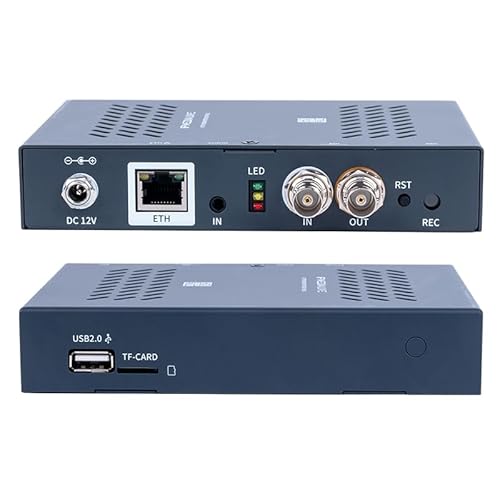
Pros
- Handles professional SDI inputs up to 1080p at 60 fps with versatile resolution downscaling support
- Supports modern low-latency transmission protocols including WebRTC, SRT, and UDP multicast for IPTV
- Generates up to four simultaneous H.265 and H.264 stream outputs from a single SDI video source
- Backed by a generous five-year manufacturer warranty and free lifetime technical support
Cons
- Lacks direct HDMI inputs, requiring separate converter hardware when connecting standard gaming consoles or consumer streaming gear
- Caps out at 1080p 60 fps encoding, offering no native 4K UHD video transmission capabilities
- Requires basic IP networking knowledge to configure through the web interface, making it less intuitive than consumer plug-and-play TV devices
The HaiweiTech SDI Video Encoder is specialized video transmission hardware engineered to bridge professional video equipment with modern IP-connected displays and streaming services. Unlike an all-in-one television display, this standalone transmitter is built to ingest broadcast-grade SDI video feeds and distribute them across local area networks to smart TVs, digital signage displays, and web platforms. It is particularly well suited for sports production teams, houses of worship, school athletic departments, and commercial venues that need to distribute high-definition live camera feeds to multiple television screens throughout a facility.
Video processing is anchored by support for SDI input resolutions up to 1080p and 1080i at 60 frames per second, alongside compatibility with standard-definition formats. Because this device is an external encoding module rather than a physical TV panel, image presentation is governed by digital compression efficiency rather than backlighting zones or nit brightness ratings. The integrated smart encoding system continuously detects stream fluctuations and dynamically regulates bitrate allocation. This intelligent compression helps preserve clean picture fidelity and fluid motion during high-action sports broadcasts and live events, minimizing visual stutter and stream dropouts on the receiving displays.
Hardware connectivity centers on a single professional SDI input port complemented by a 3.5mm analog line-in audio jack, giving operators the freedom to embed dedicated soundboard audio directly into the video stream. For outbound delivery, the hardware features an Ethernet connection capable of generating up to four concurrent H.265 or H.264 streams. It supports an expansive roster of modern networking protocols, including low-latency WebRTC and SRT, alongside established standards such as RTSP over TCP/UDP, RTMP, HTTP, HLS (M3U8), and UDP multicast. This versatility allows simultaneous streaming to public services like YouTube, Twitch, and Facebook Live while broadcasting multicast streams directly to smart televisions configured with IPTV player applications.
From an installation perspective, the unit features an ultra-compact chassis measuring 4.69 by 4.02 by 1.65 inches and weighing under two pounds. This modest profile allows it to sit discreetly on an AV shelf, attach behind an equipment rack, or tuck away inside a media console. System setup and stream parameter adjustments are managed through an intuitive web-based GUI and an included IP finder tool. While it does not feature an on-screen consumer operating system like Google TV or Roku, smart TV owners on the same local network can easily tune into the multicast or RTSP feed using compatible media player software.
There are practical limitations to keep in mind before purchasing. Because the physical video input is exclusively SDI, connecting consumer entertainment devices like a PlayStation 5, Xbox Series X, or standard HDMI camera requires an external HDMI-to-SDI conversion box. Furthermore, the unit is limited to a maximum resolution of 1080p at 60 fps, meaning it cannot encode native 4K UHD signals. Initial network configuration also assumes a working knowledge of IP routing, port assignments, and streaming URLs, which presents a steeper learning curve than standard consumer streaming hardware.
For production crews, sports organizers, and facility managers seeking a dependable way to send live SDI video across local networks to smart TVs and global streaming platforms, the HaiweiTech SDI Video Encoder delivers excellent utility. With its ability to push four simultaneous streams, broad compatibility across SRT and WebRTC protocols, and a substantial five-year warranty, it stands as a reliable, high-value component for live display distribution.
Network versatility is the strongest asset of this hardware encoder. By supporting both advanced H.265 high-efficiency compression and legacy H.264 video standards, the unit allows users to balance bandwidth consumption against receiving hardware capability. The inclusion of UDP multicast enables a single SDI camera feed to reach dozens of smart TVs and networked monitors across a local facility without multiplying local network bandwidth demands.
For internet-based broadcasting, the unit supports both traditional push protocols like RTMP for YouTube and Facebook, as well as modern low-latency standards like SRT and WebRTC. These protocols provide robust packet loss recovery and sub-second transmission latency, ensuring that live sporting events and time-sensitive presentations arrive at remote displays with minimal delay.
Frequently Asked Questions About SDI to IPTV Encoders
What is the primary advantage of using an SDI to IPTV encoder over standard HDMI capture?
BNC locking connectors and long-distance cable runs give SDI hardware superior stability for professional video distribution. Standard HDMI cables often lose signal integrity over distances exceeding thirty feet, whereas 3G-SDI cables reliably carry uncompressed video up to three hundred feet to an encoder. Dedicated units convert those robust feeds into IP packets for seamless playback on remote smart TVs and streaming receivers across local networks.
Does an Sdi To Iptv Encoder introduce noticeable latency on connected smart TVs?
Hardware encoders typically introduce minimal latency ranging between 100 and 300 milliseconds depending on protocol choice. Protocols like SRT and low-latency RTSP keep transmission tight, preventing noticeable lag during live sports broadcasts or stage presentations. High network congestion or software decoding on budget TV processors can introduce slight buffering delays if Wi-Fi connections falter.
Can a single Sdi To Iptv Encoder transmit video to multiple television displays simultaneously?
Yes, UDP multicast and RTSP streaming allow one encoder to feed unlimited client displays on a local area network. Multi-stream units like the WebRTC TF USB Recording SDI 1080P 1080i 60 Fps and Multi-channel 4K SD HD 3G 6G SDI to IP Network push multiple independent streams to platforms or TVs concurrently. Network switches handle stream replication efficiently without overloading the source encoder hardware.
Is H.265 compression necessary for 1080p and 4K TV streaming?
H.265 compression cuts network bandwidth requirements by roughly 50 percent compared to legacy H.264 formats while preserving picture detail. This bitrate efficiency is crucial when distributing high-bitrate video to television screens over crowded Wi-Fi networks where streaming stability is essential. For older displays lacking HEVC decoding hardware, dual-format encoders offer easy fallback compatibility to standard H.264 streams.
How do smart TVs receive and decode streams from an Sdi To Iptv Encoder?
Smart TVs decode streams through built-in IPTV player apps, RTSP media players, or external IP set-top boxes connected via HDMI. Display devices running Google TV, Android TV, or custom hotel middleware simply access the M3U8 playlist or RTSP network address generated by the encoder. Adding a reliable USB Wi-Fi adapter for TV setups can help maintain smooth stream decoding if existing television wireless reception is weak.
Can an Sdi To Iptv Encoder handle embedded audio alongside external microphone sound?
Yes, most broadcast encoders feature both SDI embedded audio passthrough and independent 3.5mm analog line inputs. Devices like the LILLIPUT SE1117 H.265/264 SDI Streaming Encoder allow administrators to select between embedded audio or separate soundboard feeds. This ensures dialogue intelligibility and commentary remain clear across all downstream TV screens.


Write Your Review
No reviews yet. Be the first to share your experience!