
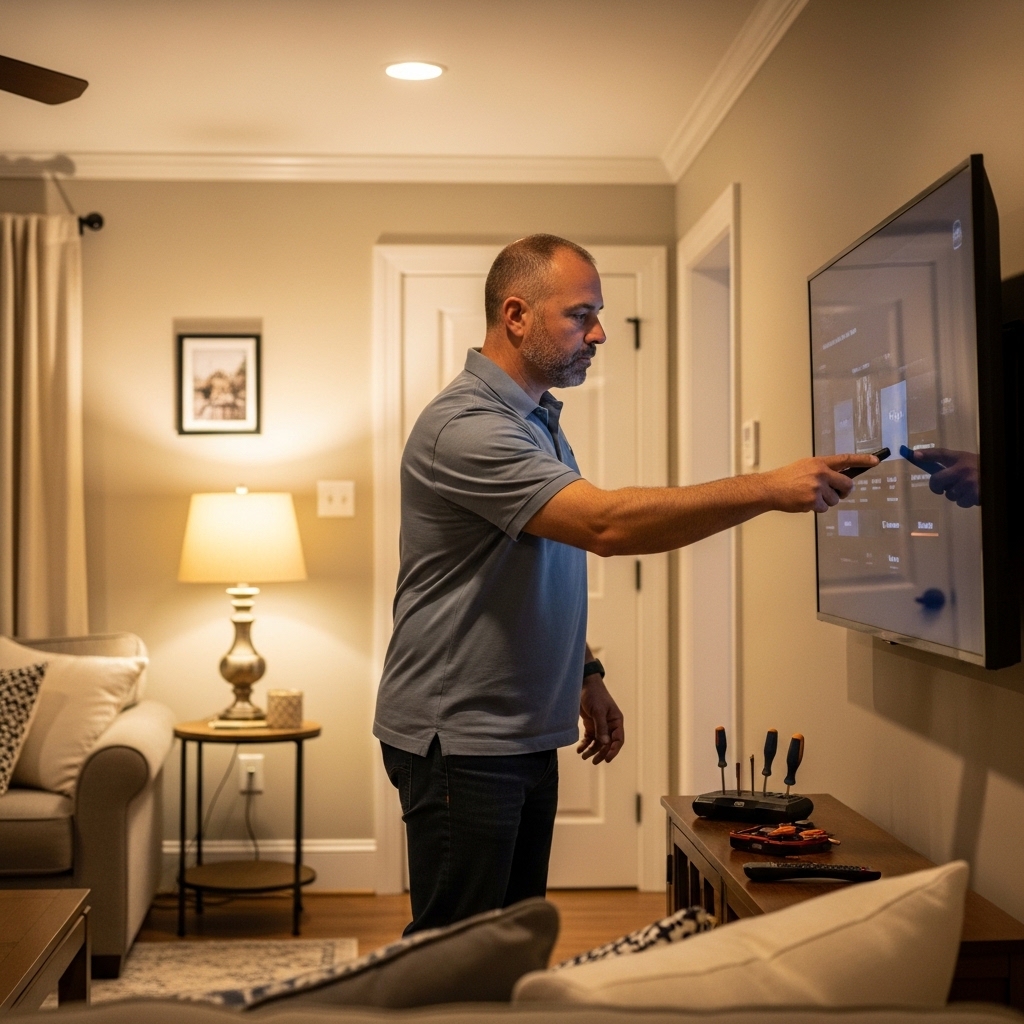

Start by connecting the antenna to the television’s antenna input, placing it where broadcast signals have a clear path, and scanning for channels; the result depends on your address and surroundings. A careful how to set up a tv antenna process also checks the TV’s input setting and the cable connection before you decide that reception is unavailable. Local terrain, nearby buildings, antenna orientation, and broadcast conditions can all affect what the television finds. A location-specific broadcast lookup can help you identify signals to investigate, but it cannot guarantee reception inside your home.
Before mounting anything permanently, try a temporary position near a window or in another open area, then scan and check the picture. Placement and a fresh channel scan are useful starting points when you’re setting up an indoor antenna or diagnosing missing stations. The TV needs a compatible digital tuner, or a suitable digital converter box if it lacks one; check the television’s documentation if you’re unsure. If you’re also adjusting display settings after connecting equipment, this 4K UHD TV setup guide explains how resolution relates to the display, which is separate from antenna reception.

Pros
- Pulls in free uncompressed over-the-air digital signals with no monthly subscriptions
- Generous 16-foot shielded coaxial cable provides plenty of reach to find the best window placement
- Upgraded internal Smart IC chip helps maintain signal stability during bad weather
- Quick and painless setup that connects straight into standard ANT/IN ports on modern digital TVs
Cons
- Channel availability and signal strength vary based on terrain and distance from broadcast towers
- May require testing multiple room locations and rescanning to achieve the highest channel count
- Older analog televisions require a separate digital converter box
The DAANT Indoor Long Range TV Antenna is a compact reception accessory built to help home entertainment enthusiasts capture free over-the-air television. Designed for cord-cutters, apartment renters, suburban homeowners, and budget-conscious families, this unit pulls down network programming without adding to monthly entertainment expenses. Whether you want to follow local NFL games on CBS and FOX, track emergency weather bulletins, or watch morning programming on NBC and ABC, this digital antenna complements any living room or bedroom television display.
When plugged into a modern 4K LED, QLED, or OLED television, an over-the-air antenna often delivers picture quality that exceeds standard cable feeds. Because broadcast stations transmit uncompressed signals directly over the airwaves, viewers enjoy sharp 1080p and 4K broadcasts with clean contrast, deep color saturation, and fewer artifacts. Sports fans will notice clear motion handling and dialogue clarity during high-stakes football games and live events, bypassing the annoying compression and delays often experienced on crowded Wi-Fi networks.
Build quality focuses on practical placement within real homes. The antenna is anchored by an included 16-foot coaxial cable constructed with a solid center conductor, dielectric insulation, and three aluminum shielding layers. This robust shielding guards against electromagnetic interference and helps shield against signal loss during thunderstorms. Its lightweight, slim black panel is easy to position behind a wall-mounted TV, mount directly against a windowpane, or tuck behind an entertainment console.
Setting up the antenna takes only a few minutes. Users simply attach the coaxial cable to the ANT/IN connector on the television, access the settings menu, select the antenna input, and run an automated channel scan. Testing both vertical and horizontal orientations near an exterior window often helps capture additional stations. Modern platforms like Google TV, Roku TV, webOS, and Fire TV automatically index these stations into an on-screen program guide, blending free local television with your daily streaming apps.
While this antenna delivers strong everyday value, practical limitations should be kept in mind. Reception is governed by local geography, distance from transmission towers, and home construction materials such as brick, stucco, or metal framing. Additionally, older analog displays will require an external converter box to process modern digital broadcasts. For viewers with digital ATSC tuners seeking an economical way to stream local channels alongside Netflix and Prime Video, this antenna makes a practical, money-saving addition.
Getting optimal signal strength from your indoor digital antenna depends primarily on placement. Positioning the antenna as high as possible against an exterior window facing nearby broadcast towers usually delivers the cleanest line of sight. Checking online coverage resources such as the FCC DTV reception map can help you determine the general direction of regional transmitters before mounting.
It is best to position the antenna away from heavy electronic appliances like microwaves, high-power wireless routers, and metallic window screens that can disrupt radio frequency signals. Remember to run a fresh channel scan on your smart TV whenever you adjust the antenna position or move it to a different wall, as the built-in tuner must re-index available frequencies.
Sports enthusiasts and local news watchers gain a major advantage with a dedicated digital antenna. Major broadcast networks carry weekly sports matchups, holiday parades, and awards shows with zero internet streaming lag. This prevents delayed reactions and spoiled plays from phone notifications before the action occurs on screen.
Because the signal travels directly through the air to your TV tuner, you also avoid the bandwidth drops, pixelation, and buffering pauses that can plague streaming services during high-traffic sporting events like playoff games. It is an efficient way to keep your home theater connected to live network television all year long.


Pros
- Affordable way to cut the cord and access live local channels without monthly fees.
- 360-degree reception and swivel design help optimize signal strength in various room layouts.
- Compact and versatile mounting options suit TVs, walls, or flat surfaces; works with most smart TVs.
- NEXTGEN TV compatible for future-proofing as ATSC 3.0 broadcasts expand.
Cons
- Range is limited to 40 miles, so it may not work well in areas with weak broadcast signals or significant obstructions.
- Indoor antenna performance can vary based on building materials, location, and interference from other electronics.
The UltraPro Hover Digital TV Antenna is a practical indoor antenna designed for U.S. homeowners, apartment renters, and cord-cutters who want to access free over-the-air local channels without the hassle of a cable subscription. This compact antenna supports 4K, 1080p, and standard HD broadcasts, making it a solid companion for smart TVs used for streaming, live sports, news, and family entertainment.
Based on product specifications and user feedback, the antenna's 360-degree reception and swivel design help users fine-tune signal strength to capture channels up to 40 miles from the broadcast source. Many cord-cutters appreciate this flexibility, as it allows them to position the antenna for the best reception in their living room, bedroom, or apartment. The ability to mount it on top of a TV, lay it flat, or stick it to a wall with included tape adds to its convenience for various setups.
For picture quality, the antenna delivers full 1080p HD and is 4K/8K Ultra HD-ready, so viewers can enjoy crisp, clear local broadcasts for news, sports, and prime-time shows. While it doesn't offer the enhanced contrast or HDR of premium streaming, it provides reliable access to network channels that many cord-cutters miss. The NEXTGEN TV (ATSC 3.0) compatibility is a forward-looking feature, promising stronger signals, richer color, and faster refresh rates as broadcasters upgrade.
Setup is straightforward: unfold the bracket to mount atop the TV, or remove it for flat placement or wall mounting. The push-on coax connector makes attaching the cable quick and tool-free. Some users may find that signal reception varies based on their distance from broadcast towers, building materials, or interference from other electronics, which is typical for indoor antennas.
Overall, the UltraPro Hover Digital TV Antenna is a budget-friendly solution for families, streamers, and gift buyers looking to cut the cord without sacrificing live local content. It works with all major TV brands and smart platforms, making it a practical addition to any home theater, bedroom, or apartment setup. While not a replacement for a full cable package, it's a smart way to enjoy free HD channels and supplement streaming services.


Pros
- Pulls in free over-the-air high-definition broadcast channels like ABC, CBS, NBC, and Fox without subscription fees
- Generous 16.5-foot coaxial cable offers ample slack to position the antenna near windows for optimal signal capture
- Leaves television HDMI ports open by connecting directly to the rear RF coaxial antenna terminal
- Durable flame-retardant PC construction resists moisture and supports both indoor and sheltered outdoor placement
- Magnetic base provides stable placement on metal surfaces or flat entertainment consoles
Cons
- Broadcast reception quality and channel count depend heavily on distance to local transmission towers and terrain
- Initial assembly is required, including removing the protective rubber sleeve before screwing the base to the antenna linkage
- Moving the antenna requires initiating a complete channel rescan through your television settings menu
The intelbras digital TV antenna serves as a practical broadcast reception accessory engineered to pair with modern televisions, from compact 24-inch and 32-inch bedroom displays up to expansive 65-inch and 75-inch living room screens. Designed for cord-cutters, sports enthusiasts watching Sunday football, and budget-conscious households, this antenna enables any HDTV or 4K smart TV equipped with an internal digital tuner to capture free over-the-air programming. By delivering major local networks such as ABC, CBS, NBC, and Fox without ongoing subscription costs, it provides American households with an accessible gateway to local news and live broadcast events.
In everyday viewing, over-the-air digital signals often deliver a cleaner, less compressed high-definition picture than standard cable or low-bitrate live streaming feeds. Supporting 1080p and digital broadcast formats up to 4K where transmitted, the antenna feeds direct uncompressed broadcast data straight to your television's internal ATSC tuner. This helps your television display panel render fast-action live sports and local programming with reduced digital artifacting, minimal motion judder, and crisp line definition across both standard 60Hz panels and high-refresh-rate living room displays.
Hardware integration is straightforward, utilizing an included 16.5-foot coaxial cable that attaches directly to the RF antenna input labeled 'CABLE-ANT IN' on the back of your television chassis. Because this antenna utilizes the television's dedicated coaxial tuner input, it preserves all available HDMI inputs, leaving high-bandwidth HDMI 2.0 and HDMI 2.1 ports completely open for gaming consoles like the PlayStation 5, Xbox Series X, or dedicated streaming players. The antenna itself features flame-retardant double PC construction for moisture resistance, along with a magnetic base and linkage screw that support tabletop placement, window mounting, or exterior positioning.
Operating the antenna is managed entirely through your television's native operating system, whether your display runs Google TV, Roku TV, Fire TV, or another smart platform. Once the coaxial connection is secured, users navigate to the TV settings menu and run a digital channel scan. The discovered channels automatically integrate into the television's built-in live TV guide, allowing seamless switching between over-the-air broadcasts and installed streaming applications using your standard television remote. The generous 16.5-foot cable length ensures you can route wiring neatly around media consoles to place the antenna near an exterior window where signal line-of-sight is strongest.
Prospective buyers should keep in mind that over-the-air antenna performance is inherently subject to geographic factors, including distance from local broadcast towers, dense building materials, and surrounding topographic barriers. If initial scans reveal few channels or signal dropouts, relocating the antenna higher up or closer to a window and performing another channel search is standard procedure. Furthermore, initial assembly requires removing the protective red rubber sleeve from the magnetic base to screw the unit together properly, and channel availability will strictly reflect what local affiliates broadcast in your specific area.
For viewers seeking a cost-effective way to supplement their smart TV streaming setup with free, high-definition local broadcasting, the intelbras digital TV antenna offers solid practical value. Its extended 16.5-foot cable, weather-resistant housing, and flexible magnetic mounting provide convenient installation across bedrooms, kitchens, and primary home theaters alike. It stands as a reliable, budget-friendly hardware companion for any television owner looking to access local sports and network television without a monthly cable bill.
Over-the-air broadcast television remains one of the primary methods for catching major sporting events on networks like CBS, Fox, and NBC. Unlike live internet streaming platforms that often suffer from compression artifacts, buffering, or broadcast latency, signals received directly through an antenna deliver uncompressed high-definition feeds straight to your display.
When watching fast-paced sports on your television, whether it features a native 60Hz panel or a high-refresh-rate 120Hz display, receiving an uncompressed broadcast signal helps prevent macroblocking and trailing around fast-moving balls and athletes. This makes an indoor digital antenna an effective tool for sports fans who demand stable, high-clarity viewing during big games.
The antenna connects through a standard 75-ohm coaxial cable directly to your television's RF input terminal. By utilizing the internal ATSC broadcast tuner built into your TV, this connection does not take up any of your valuable HDMI ports, leaving them completely available for gaming consoles, Blu-ray players, and dedicated streaming hardware.
With 16.5 feet of coaxial cabling included, you have substantial placement flexibility to route the wire along baseboards, behind entertainment centers, and up toward an exterior window where broadcast signal penetration is strongest.
Readers working through this often check best outside tv antenna next.
Set up a TV antenna and verify reception
A reliable setup starts with the right connection and a position you can test safely, not with a promise that a particular antenna will receive particular stations. Availability and reliability can vary by address, terrain, distance and direction to broadcast transmitters, buildings, placement, cabling, and broadcast conditions. Connect the antenna to the TV’s antenna input, select the over-the-air or antenna source in the television menu, and run its channel scan. Then check whether the channels found remain watchable from the intended seating position.
Use this initial checklist before changing equipment or making a permanent installation.
- Confirm the television has a digital tuner or use a compatible digital converter box.
- Identify the TV’s antenna input and connect the coaxial cable securely.
- Choose an accessible test position away from obvious obstructions.
- Select the television’s antenna or air source before starting a channel scan.
- Keep notes on scan results and picture stability at each test position.
Check the television and antenna connection
Look for a threaded coaxial input labeled ANT IN, ANTENNA, or a similar term on the television. Some TVs share an input label with cable service, so use the television manual or menu to confirm that it supports an antenna source. A smart-TV label alone does not establish whether a set has a built-in over-the-air tuner. Older analog televisions may need a digital converter box, and the box must connect to the antenna and television according to its instructions.
Inspect the cable ends for visible damage and make sure the connector fits the input without being forced. A loose connection can interrupt the signal, while a damaged cable or connector can make a scan unreliable. If the antenna has a separate amplifier or power supply, follow the supplied product instructions for its connection and power requirements. Do not assume every antenna is amplified or needs power, and do not add a power unit unless the setup calls for one.
Keep the initial connection simple: antenna to TV, without a splitter or extra distribution equipment if those parts are not needed. Each additional connection creates another possible point to check, and splitters can affect the signal reaching a television. If the antenna is intended to serve more than one TV, consult the splitter and antenna instructions rather than guessing at wiring or power arrangements. A simple baseline helps you distinguish a connection issue from a placement or availability problem.
Choose a test position that fits the room
For an indoor antenna, begin in an open spot where you can adjust its position without stretching or trapping the cable. A window may be worth testing, but it is not automatically the strongest location; the direction of local broadcast sources and the building’s materials matter. Concrete, metal, dense walls, and nearby structures can obstruct or alter reception. A position higher in the room may help in some homes, but compare actual scan and viewing results rather than treating height as a guarantee.
Directional antennas need their orientation considered, while multidirectional designs are marketed for signals arriving from more than one direction. Those descriptions do not remove local obstacles or ensure a station is receivable. If reliable local information identifies likely transmitter directions, use it as a starting point for positioning, then adjust the antenna and rescan. If the directions are uncertain, test reasonable positions and record what changes instead of assuming a compass direction will solve every reception issue.
Attic and outdoor locations may offer different placement possibilities from a living room, but they also add installation constraints. An attic can still have obstructions from roofing, insulation, wiring, or nearby structures. Outdoor mounting introduces exposure, mounting, cable-routing, and grounding considerations. Renters should check lease terms and building rules before attaching equipment to a window, balcony, exterior wall, or roof.
Run a channel scan after each meaningful change
Open the TV’s setup or channel menu and choose the option intended for antenna, air, or over-the-air reception. The exact wording and menu path vary by television, so refer to the TV manual rather than relying on a universal sequence. Start an automatic channel scan and let it finish before changing the antenna position or disconnecting the cable. A scan checks for channels the tuner can identify under the conditions at that moment; it does not establish that every locally available station will be found.
Some televisions retain earlier scan results, so repeat the scan after moving the antenna or correcting a connection. If you change a menu source from cable to antenna, scan again using the correct source. Keep the television on a channel found during the scan and watch for a stable picture and sound, not just a station name in the channel list. A channel that appears in a scan may still have intermittent reception.
These checks help make each scan useful.
- Wait for the current scan to finish before assessing its results.
- Record the antenna position and orientation for each scan.
- Check picture and sound stability on channels the TV identifies.
- Rescan after changing position, cabling, source settings, or equipment.
- Compare results at different times if reception appears intermittent.
Separate missing channels from an unstable signal
A channel missing from the scan can have several possible explanations: it may not be available at the address, its signal may be obstructed, the antenna may be poorly positioned, or the TV may be set to the wrong source. A channel that appears but breaks up points to a different symptom, although the underlying cause can still involve placement, cabling, interference, or changing broadcast conditions. Avoid treating either symptom as proof that a longer advertised range or a booster will fix the setup. First check local availability and confirm the TV and antenna connection.
Move the antenna to one practical position at a time, then rescan and check the result. If the scan improves or a previously unstable channel becomes watchable, note the position so you can reproduce it. If results worsen, return to the earlier location and continue testing without changing several things at once. A location-specific broadcast lookup can provide context about stations to investigate, but actual reception still needs to be verified with the home setup.
Amplification is not a universal remedy. An amplifier may help in some setups, but it cannot substitute for a usable signal or suitable placement, and its effect depends on the full system. If an amplified antenna is already in use, confirm that any required power connection is installed as directed. Avoid adding multiple amplifiers or changing power connections without instructions, because doing so may complicate diagnosis instead of improving reception.
Understand antenna claims and setup differences
Product descriptions may mention a claimed range, channel count, picture resolution, or broadcast standard. Those claims do not show which stations will reach a particular address, and resolution wording does not guarantee a particular channel or picture quality. The television’s tuner, the broadcast signal, and the reception path all matter. Treat advertised figures as product claims unless independent evidence with relevant test conditions is available, and do not use them as a substitute for local signal information.
Specifications that can help plan a setup include antenna type, connector, cable length, stated power needs, included mounting pieces, and the intended indoor or outdoor use. Check those details against the installation location and the TV input before purchase or mounting. A supplied cable length can affect where an antenna can be tested, but it does not establish reception quality. If a product description is unclear about compatibility, assembly, or power, consult the manufacturer’s instructions before proceeding.
Indoor antennas are usually simpler to reposition, while attic or outdoor placement may require more planning and permission. A directional design can call for orientation toward relevant broadcast sources; a multidirectional design may reduce the need to point toward a single direction, but neither design overcomes every obstruction. Passive and amplified setups also have different connection needs. Choose a configuration that suits the location and can be installed safely, rather than selecting by a headline range claim alone.
Install attic or outdoor equipment safely
Temporary indoor testing can help establish whether a proposed antenna position is worth pursuing before any permanent work. For an attic or exterior installation, follow the antenna and mounting-hardware instructions and applicable local requirements. Consider safe access, weather exposure, cable routing, and the building’s rules before beginning. Do not work near power lines or attempt roof or ladder work that exceeds your ability; contact a qualified installer when the job presents a hazard.
Outdoor antenna systems may have grounding and lightning-protection requirements, and those must not be bypassed. Do not improvise electrical connections or omit required protections to simplify installation. Ask a qualified professional if you cannot verify what the installation requires. For apartments and shared buildings, obtain permission where needed and avoid permanent attachments or cable routing that violates building rules.
Keep cables routed so doors, windows, furniture, and walkways do not pinch or damage them. Use only mounting methods and materials appropriate to the antenna and location, as specified by the manufacturer. A setup that scans successfully indoors does not by itself prove that an exposed outdoor installation is secure or suitable for weather. Recheck the system according to its instructions, especially after equipment or cable changes.
Verify the finished setup and decide what to change
After the scan, check the channels you care about at the intended viewing location and confirm that the picture remains stable. Repeat the scan only after a meaningful change, such as moving the antenna, correcting a cable connection, or selecting the proper source. If reception remains poor, review local availability, building obstructions, antenna orientation, and cable condition before replacing equipment. Changing one factor at a time makes it easier to tell whether the adjustment helped.
A splitter, long cable run, or added component may change the signal path, so test the simplest connection first when troubleshooting. If a basic direct connection works but a shared setup does not, check the added components and their instructions. Do not assume a new scan will overcome a weak or blocked signal. Keep a record of working positions and settings so future changes can be compared with a known baseline.
Connect the antenna, select the TV’s antenna source, test a safe position, and scan; then verify reception where you watch. Check local availability and adjust one variable at a time if channels are missing or unstable, without assuming any setup guarantees specific stations.
If this topic is part of a bigger decision, best digital antenna for smart tv is a useful related read.




Write Your Review
No reviews yet. Be the first to share your experience!