

Start by choosing a safe mounting location and confirming that the antenna can connect to your television or signal equipment; the result depends on your address and installation conditions. This how to install an outdoor tv antenna step by step setup guide explains how to plan placement, assemble and mount equipment according to its instructions, route coaxial cable, and scan for channels. A location-specific broadcast lookup can help you identify signals to investigate, but it cannot promise which channels your finished setup will receive. Terrain, nearby buildings, trees, antenna direction, cable condition, and broadcast conditions can all affect reception.
Outdoor placement can help avoid some indoor obstacles, but it also brings mounting, weather exposure, cable routing, and safety considerations. Check whether your home, rental agreement, building rules, and chosen mounting point allow the installation before buying or drilling. Product descriptions may list features such as a J-mount, coaxial cable, splitter, amplifier, or weather-resistant construction, but those details vary by model and do not establish how reception will perform at your address. Plan to verify the connection and scan channels after installation, and avoid roof or ladder work that you cannot do safely.

Pros
- Long 70-mile range with strong signal reception for a wide variety of channels
- Easy to install with included mounting hardware; works outdoors or in attic
- Supports 4K/8K and NEXTGEN TV for future broadcast upgrades
- Durable weather-resistant build handles rain, snow, and sun
- Backed by lifetime replacement guarantee and responsive U.S. tech support
Cons
- May require precise aiming and adjustment for optimal signal strength in challenging locations
- Antenna is relatively large and may not suit tight spaces or homeowners with HOA restrictions
- Some users might need additional amplifier or splitter if connecting multiple TVs
Looking to cut the cord without losing access to your favorite local channels? The UltraPro Outdoor HD Digital Long Range Smart TV Antenna is a practical solution that brings in free over-the-air broadcasts with impressive clarity. Designed for American homeowners and apartment renters who want reliable access to network TV, sports, and news, this antenna picks up VHF and UHF signals from up to 70 miles away. It's especially useful for cord-cutters, streamers, and families who want to combine free OTA channels with streaming services like Netflix and Hulu.
Picture quality is excellent for an antenna. The UltraPro supports 4K and 1080p HD broadcasts, so you get crisp, clear images on modern TVs. It is also NEXTGEN TV (ATSC 3.0) compatible, meaning you'll be ready for the next generation of over-the-air TV with better audio, color, and refresh rates as it rolls out. Many users find that local sports, news, and prime-time shows look just as good as cable - without the monthly bill. The antenna's long range works well in both suburban and rural areas, though performance depends on your distance from broadcast towers and any physical obstructions.
Build quality is solid for outdoor use. The antenna comes with a weather-resistant bracket, J-mount, and mast clamp, so you can mount it on your roof, side wall, or in an attic. The rugged construction holds up against wind, rain, and sun. Setup is straightforward: attach the antenna to the mount, run a coaxial cable to your TV or converter box, and scan for channels. The included hardware makes installation manageable for most DIYers. If you run into trouble, UltraPro offers free U.S.-based tech support during business hours.
One limitation is that the antenna's size might be a factor if you have limited outdoor space or strict HOA rules. Also, you'll need to experiment with positioning to get the best signal - a few degrees can make a difference. For apartments or homes with shared antennas, this might not be ideal. Additionally, if you're splitting the signal to multiple TVs, you may need an amplifier to maintain strength.
Overall, the UltraPro Outdoor HD Digital TV Antenna is a solid investment for anyone looking to reduce monthly entertainment costs while keeping access to live local broadcasts. It's especially valuable for sports fans who need reliable reception for big games, news watchers, and families who want diverse content without subscription creep. Pair it with a streaming device like Roku or Fire TV, and you have a complete home entertainment system that's budget-friendly and future-proof.

Pros
- Strong long-range reception with 4K support for future-proof cord-cutting.
- Weather-sealed housing and included J mount for secure outdoor or attic mounting.
- Easy to install with clear instructions and standard coaxial connection.
- Affordable one-time cost that eliminates monthly cable or satellite bills.
Cons
- May require careful aiming and occasional adjustment for optimal signal in areas with obstacles like hills or tall buildings.
- Outdoor installation can be more complex than indoor antennas; requires tools and possibly professional help.
- Signal reception can be affected by weather conditions (heavy rain, snow) or nearby electronics.
The GE Outdoor HD Digital TV Antenna (model 29884) is a long-range antenna designed for homeowners and apartment renters who want to cut the cord and enjoy free over-the-air TV. It supports both VHF and UHF bands and can receive 4K and 1080p HD signals from broadcast towers up to 60 miles away. This makes it a great choice for streamers, sports fans, movie lovers, and families who want to watch local news, live sports, and network shows without a monthly subscription.
In real-world use, the antenna's reception quality depends on your location and the placement of the antenna. The included J mount allows for secure installation on a roof, exterior wall, or in an attic, giving you flexibility to find the sweet spot for signal strength. According to user feedback, many find that attic mounting offers good reception while keeping the unit out of sight and protected from the elements. The weather-resistant housing helps it withstand rain, snow, and UV exposure, so it can stay outdoors reliably for years.
One of the key advantages of this GE antenna is its compatibility with modern smart TVs from Samsung, LG, Sony, TCL, Hisense, and others. It connects via a standard coaxial cable (not included) to the TV's antenna input. Once connected, you can run a channel scan and start watching broadcast channels immediately. The antenna also works with streaming devices like Roku, Fire TV, and Apple TV, but those devices don't replace the antenna - they add streaming services. For cord-cutters, this antenna is the essential first step to getting local channels for news, sports, and prime-time shows.
Build quality is solid for the price point. The antenna is made of durable materials with a gray and white finish that blends with most exteriors. The J mount is sturdy and includes hardware for mounting. However, installation does require some DIY skill - you'll need to drill holes, route the coaxial cable, and possibly use a signal amplifier if you're far from towers. The antenna itself is not amplified, so if you're in a weak signal area, you might need a separate preamplifier (sold separately).
Potential limitations include dependency on line-of-sight to broadcast towers. In areas with heavy tree cover or hills, reception can be spotty and may require repositioning. Also, because it's an outdoor antenna, it's subject to weather-related fading during severe storms. The absence of a built-in amplifier means it's best suited for areas with moderate to strong signals. For those living in apartments with no outdoor access, this model might not be feasible - consider a smaller indoor antenna instead.
Overall, the GE Outdoor HD Digital TV Antenna is a reliable, affordable option for U.S. households looking to cut the cord. It's especially ideal for homeowners with a clear view of the sky who want to watch local sports, news, and network TV in high definition. Setup takes a bit of effort, but the long-term savings and picture quality make it worth the work. If you're a streamer who misses live TV or a family wanting to reduce monthly bills, this antenna is a practical addition to your home entertainment system.

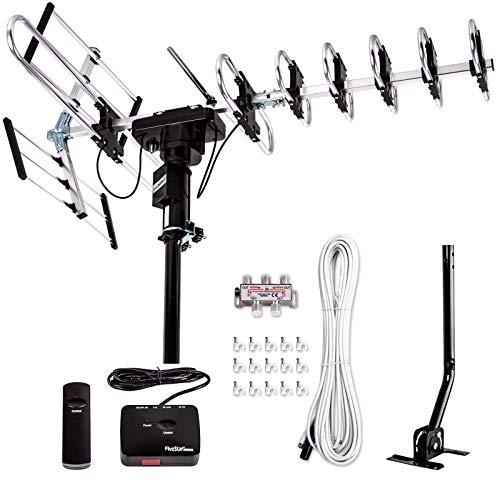
Pros
- Supports uncompressed 4K and 1080p digital reception for crisp, artifact-free TV picture quality
- Motorized 360-degree rotation allows convenient directional tuning from inside your living room
- Includes a comprehensive installation package with J-pole mounting hardware, splitter, and coax cable
- Capable of feeding broadcast signals to multiple televisions simultaneously throughout the household
Cons
- Long-range reception performance can be affected by dense tree lines, valleys, and heavy building obstructions
- Outdoor roof or attic mounting requires basic DIY wiring and physical installation effort
- Multi-room setups may require additional coaxial cabling depending on the layout of your home
The Five Star Outdoor Digital Amplified HDTV Antenna is an outdoor motorized television antenna system engineered to capture free, over-the-air digital broadcasts for modern smart TVs, 4K displays, and multi-room home entertainment systems. This antenna setup is tailored for cord-cutters, budget-conscious homeowners, sports enthusiasts, and families who want reliable access to local network broadcasts without paying recurring monthly cable or satellite fees. Whether you are outfitting a primary living room 4K OLED TV or distributing signals to multiple bedroom displays, this unit provides a versatile pathway to free television programming.
For viewers who care deeply about visual fidelity, over-the-air broadcasts often deliver superior picture quality compared to standard cable feeds or compressed streaming platforms. Based on product specifications, this antenna captures native uncompressed 1080p, 1080i, and 720p signals, along with next-generation broadcast formats up to 4K resolution where available. Sports fans hosting Super Bowl watch parties or tracking live college football games will appreciate the sharp motion clarity, vibrant colors, and lack of streaming buffering on local network channels such as FOX, CBS, NBC, and ABC.
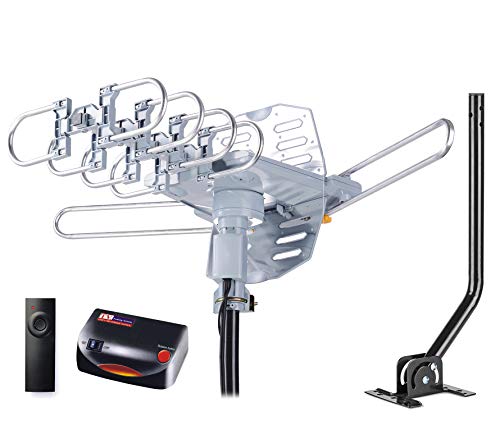
Under the hood, the antenna features an advanced reception design combining six UHF reflector elements with a dedicated VHF band. The system incorporates an auto gain control chip providing 15 to 35 dB of booster gain, which assists in pulling in distant transmission towers across broad frequency bands. The integrated 360-degree motorized rotor is operated via an indoor controller, enabling homeowners to dial in signal direction directly toward local transmitters without having to climb up a ladder or manually readjust the pole in rough weather.
Physical construction focuses on durable weather resistance, featuring weather-shielded components and wind-resistant reflectors designed to withstand outdoor conditions. The package includes an installation kit featuring a J-pole mount, 40 feet of coaxial cable, and a multi-port splitter capable of driving feeds to up to five televisions at once. This makes it practical to connect a high-end living room home theater, a basement gaming display, and family bedroom TVs through a centralized antenna distribution setup.
Real-world reception always depends on local geographic factors, including distance from regional broadcast towers, natural terrain, hills, and surrounding building density. While the manufacturer lists long-range capabilities, suburban and rural users situated behind heavy ridges or dense forest canopies may need to experiment with placement between attic and outdoor roof mounting. In addition, routing coaxial cables into multiple rooms requires some basic DIY effort and patience during initial channel scanning on each smart TV tuner.
For households seeking to eliminate recurring television bills while maximizing the picture clarity on their 4K TVs, the Five Star Amplified HDTV Antenna represents a practical and cost-effective home entertainment upgrade. It bridges the gap between streaming apps and live broadcast television, giving sports lovers, news followers, and movie viewers reliable access to pristine broadcast channels across every room in the home.
Setting up the Five Star antenna is designed to be straightforward thanks to the included mounting hardware and cabling accessories. Homeowners can install the provided J-pole on an exterior roof fascia, chimney, or within a high attic space to preserve exterior roof lines while maintaining clear line-of-sight toward broadcast towers.
Once mounted, connect the 40-foot coaxial cable to the control box indoors, and attach the multi-way splitter to distribute feeds to separate TV inputs. After running a quick digital channel scan on your smart TV menu, you can tap the rotor button to reposition the antenna angle and optimize signal strength for stubborn channels.
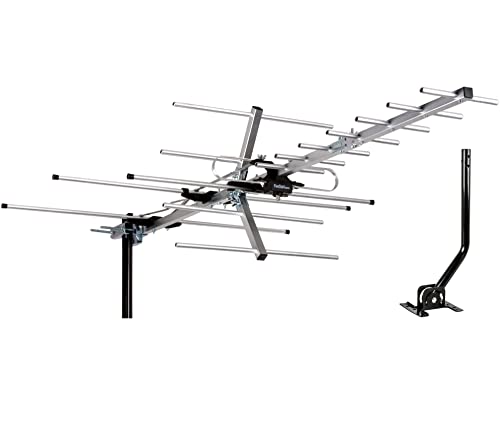
Pros
- Impressive 200-mile range capability for picking up distant broadcast towers (actual range varies by location).
- Solid weatherproof build suitable for year-round outdoor mounting - resists wind, rain, and lightning.
- Includes essential mounting hardware and long coax cable - no extra purchases needed for basic installation.
- Excellent value for cord-cutters wanting to access free local channels in HD without ongoing costs.
Cons
- Assembly required for some parts - not fully pre-assembled out of the box.
- Actual reception range heavily depends on your distance from broadcast towers and physical obstructions like hills or buildings.
- No built-in amplifier - may need a separate signal booster in weak signal areas or for long cable runs.
The Five Star Yagi TV Antenna is an outdoor/indoor antenna designed for cord-cutters, homeowners, apartment renters, and anyone looking to ditch expensive cable subscriptions while still enjoying free local broadcast television. This antenna is not a TV itself but a powerful accessory that pulls in over-the-air (OTA) signals from local stations, including ABC, CBS, NBC, Fox, PBS, and more, in resolutions up to 4K and 1080P. It's a practical solution for families, sports fans, and streamers who want live news, sports, and network shows without monthly fees.
In terms of performance, the Yagi design features extended receiving elements and an upgraded smart chip that claims to capture signals up to 200 miles away. Real-world results will vary based on your location relative to broadcast towers and any obstructions like trees or buildings. Many users report strong reception for local channels in suburban and rural areas, especially when mounted high on a roof or in an attic. The antenna handles both VHF and UHF frequencies, which covers most digital channels. It does not have a built-in amplifier, so if you live far from towers or have a long cable run, you might need an external preamplifier for optimal performance.
Build quality is a highlight - the antenna is made with durable, weather-resistant materials that can withstand rain, wind, and lightning. It's designed for outdoor mounting but can also be placed in an attic for a cleaner look. The package includes a 20-inch mounting pole and 40 feet of coax cable, which is generous and saves you from buying extra parts. The assembly is partially pre-assembled, so you'll need to attach the remaining elements - it's straightforward and takes about 15-20 minutes.
Setting up the antenna is fairly simple: choose a location with a clear line of sight to broadcast towers if possible, mount the pole securely, attach the antenna, run the coax cable to your TV, and scan for channels. The included cable is long enough for most installations, but you can extend it if needed. The antenna works with any digital TV or converter box, and it's compatible with FM radio signals as well. One limitation is that the antenna is fairly large (17 x 8 x 6 inches) and may be noticeable if mounted outdoors, but that's typical for high-gain Yagi designs.
Overall, the Five Star Yagi TV Antenna is a solid choice for anyone wanting to cut the cord and access free local channels. It's especially good for homeowners with a clear view of towers, apartment renters with attic access, or families who want to supplement streaming services with live TV. The value is excellent given the included mounting hardware and cable. Just be realistic about your location and consider a signal amplifier if needed. For the price, it's a reliable way to get local news, sports, and entertainment without monthly bills.
Installing the Five Star Yagi TV Antenna is a straightforward DIY project. Start by determining the best location - ideally a roof, attic, or eave with a clear line of sight toward the nearest broadcast towers. Use the included 20-inch mounting pole to secure the antenna to a mast, chimney strap, or wall bracket (not included). Attach the pre-assembled antenna to the pole using the provided hardware. Run the 40-foot coax cable from the antenna to your TV or converter box. Connect the cable to the antenna's F-connector and tighten. On your TV, go to the settings menu and select 'Channel Scan' or 'Auto Program' to detect all available over-the-air channels. For best results, aim the antenna toward the direction of broadcast towers - you can use websites like AntennaWeb or FCC DTV Reception Maps to find tower locations. If you have weak signals, consider adding a preamplifier or a signal amplifier near the TV. The antenna is weatherproof, but ensure all connections are sealed with weatherproof tape or silicone to prevent moisture damage. Once installed, enjoy free HD channels without monthly fees.
If this topic is part of a bigger decision, best outside tv antennas for digital tv is a useful related read.
Install and verify an outdoor TV antenna safely
Install an outdoor TV antenna by planning a permitted, safe location, assembling and securing the antenna as its manufacturer directs, connecting suitable coaxial cable, and scanning for channels on the television. Check reception with your actual setup before treating the installation as complete. Local availability and reliability vary with address, terrain, buildings, trees, antenna orientation, cable routing, and broadcast conditions.
Use the instructions supplied with the antenna and mounting hardware rather than assuming that products with similar shapes assemble the same way. The product information supplied for some options mentions a J-mount, pole, cable, or splitter, but those items are not included with every antenna. Confirm what is in the package and what your installation requires before starting.
This preparation list helps catch common issues before work begins.
- Check local broadcast availability for your address before choosing a location.
- Review the antenna, mount, cable, and television instructions for their specific requirements.
- Confirm permission, mounting limits, and any applicable building or local requirements.
- Choose a cable route that avoids damage, trip hazards, and unsuitable openings.
- Gather the listed mounting hardware and compatible coaxial connections.
- Plan a safe way to work, or arrange qualified help if access is hazardous.
Check broadcast conditions and the mounting location
Begin with a location-specific broadcast lookup, which can show the direction of transmitters and the signals to investigate near your address. Treat its information as a planning aid, not a guarantee: the lookup does not account perfectly for every obstruction, indoor connection, antenna position, or changing broadcast condition. A nearby hill, dense building, or stand of trees may affect reception even when a transmitter appears relatively close.
Compare feasible mounting locations for safe access and a clear cable path. An outdoor position may reduce some obstructions compared with an indoor location, but no mounting height or location is universally best. Trees, walls, roofing, nearby structures, and the direction of relevant broadcast sources all matter; a location that seems convenient may not be the location that works best for your household.
Decide whether an outdoor installation is permitted and practical before committing to it. Renters may need permission, while homeowners may need to account for property rules, mounting surfaces, and cable entry points. If the suitable position requires working near power lines, climbing an unsafe ladder, or accessing a roof without proper precautions, do not proceed yourself; consult a qualified installer.
Identify the antenna, television, and connection path
Read the antenna instructions to identify its parts, mounting requirements, connectors, and any power or amplifier arrangements. Do not assume that every outdoor antenna is passive or that every amplified antenna uses the same power method. Check the television’s input and instructions as well, particularly if the setup uses a converter box or other equipment between the antenna and the screen.
A coaxial cable carries the antenna connection to compatible television equipment, but an unsuitable or damaged cable, loose connector, or unnecessary splitter can complicate reception. Verify the connector type and cable route against the instructions and the equipment you actually have. A splitter is relevant only when the setup is designed to feed multiple televisions, and adding one may affect signal levels; do not assume that a package accessory is needed for a single television.
Product descriptions can help distinguish included parts without establishing that an antenna is suitable for every address. For example, the UltraPro Outdoor HD listing identifies a J-mount and mounting hardware, while the Five Star Outdoor Digital Amplified HDTV Antenna listing describes a cable and splitter in its installation kit. Verify the current package details and instructions for the specific item rather than transferring one model’s features to another.
Assemble and secure the outdoor mounting hardware
Assemble the antenna and mount in the order and orientation shown in the manufacturer’s instructions. Keep the work at ground level when possible, and use only the parts and mounting surfaces the instructions specify. Do not improvise a bracket, remove required hardware, or assume that a mount designed for one surface is appropriate for another.
Before raising or securing the assembled equipment, check that its components are attached as directed and that the chosen support is suitable. Follow the supplied instructions for fastening and positioning; this guide cannot provide model-specific mounting steps because the products and mounting arrangements differ. If the surface is damaged, the hardware is missing, or the installation would be unstable, stop and resolve the issue before proceeding.
Outdoor work involves risks beyond the antenna itself, including falls, electrical hazards, and exposure to lightning. Do not install or adjust equipment in unsafe weather, near power lines, or from a roof or ladder you cannot use safely. Follow manufacturer guidance and applicable local requirements, including any rules relevant to grounding and outdoor equipment; seek qualified help where the work exceeds your ability.
Route coaxial cable and connect the television
Route the cable from the antenna to the television or other compatible equipment without creating a trip hazard or leaving it vulnerable to avoidable damage. Follow the antenna and cable instructions for outdoor routing and entry into the building. Do not invent a cable-entry or weather-sealing method; use suitable materials and procedures specified for the installation.
Make the connections described in the equipment instructions, checking that each connector is appropriate and secure. If the setup includes an amplifier or preamplifier, follow its specified connection and power arrangement instead of treating it as a universal accessory. An amplifier may help in some setups, but it cannot replace suitable antenna placement or a usable signal, and amplification is not automatically beneficial.
Connect the antenna feed to the television’s antenna input, or to the designated input on a compatible converter box if the instructions call for one. Select the television’s over-the-air antenna or broadcast mode rather than a cable input mode when appropriate for that device. Menu names and controls vary by television, so use its manual if the relevant setting is unclear.
If this topic is part of a bigger decision, best digital antenna for smart tv is a useful related read.
Scan channels and assess reception at the television
Start an antenna or over-the-air channel scan through the television’s menu once the physical connections and input mode are set. Follow the television manufacturer’s instructions because the menu sequence varies by model. Let the scan finish before judging its results; interrupting it or selecting the wrong input mode can leave the channel list incomplete.
Check whether the channels found are usable rather than relying only on the number shown by the scan. A channel can appear in a list yet produce a picture that breaks up or disappears. Test the channels you care about at the television, and note whether problems affect one channel, several channels, or the entire setup.
Use these checks to narrow down a problem without assuming a single cause.
- Confirm that the television is set to its antenna or over-the-air input mode.
- Check that the coaxial cable connects to the intended antenna input.
- Inspect accessible connectors for a loose fit or visible damage.
- Confirm any amplifier follows its specified connection and power instructions.
- Rescan after changing equipment, connections, or antenna placement.
- Compare reception at different times if conditions appear intermittent.
Diagnose missing, weak, or intermittent channels
If the scan finds no channels, first verify the selected input and the connection path from antenna to television. Check accessible cable connections and confirm that any required amplifier arrangement follows its instructions. Then repeat the scan using the television’s antenna setting. A missing channel does not, by itself, prove the antenna is defective; local signal conditions and obstructions may also explain the result.
If only some channels are absent or unreliable, consider whether they come from different directions or face different obstructions. Directional antennas may need orientation suited to the relevant broadcast sources, while a multidirectional design does not eliminate the effects of terrain, buildings, or placement. Use available local broadcast information as a guide, then make only safe, permitted adjustments and scan again to verify what changed.
Pixelation or dropouts can have several possible causes, including a loose connection, damaged cable, unsuitable placement, obstruction, or changing reception conditions. Inspect only accessible connections and equipment, and follow the instructions before making adjustments. Avoid adding amplification as the default fix: an amplifier cannot create a usable signal where conditions do not support reception and may not solve a placement or connection issue.
When reception is inconsistent, record which channels are affected and what changed before the problem began. A recent move, cable change, new splitter, or altered antenna position can help identify the relevant part of the setup. If you cannot safely access the outdoor equipment, or the fault appears to involve mounting, electrical safety, or grounding, leave the work to a qualified installer.
Understand advertised range and installation claims
Advertised range and channel-count figures are not promises about reception at a particular home. Product descriptions may use large range claims, but the supplied information does not establish that those distances are independently verified or achievable under every condition. Distance alone does not account for terrain, transmitter direction, buildings, trees, cable routing, antenna placement, or local broadcast conditions.
Check what a listing actually specifies: antenna type, mounting location, included cable or hardware, amplifier arrangements, and any stated compatibility information. Treat stated performance as a manufacturer claim, not a measured result for your address. The product information supplied here does not provide location-specific reception evidence, so it cannot determine which channels an individual installation will receive.
More than one television, a long cable route, or a splitter can change the connection setup and deserves attention before installation. Confirm that the antenna and any included components are intended for the arrangement you plan to use. Avoid assuming that a claim about supporting multiple televisions means reception will be the same on every television or at every outlet.
Verify the finished installation and plan future changes
After scanning, confirm that the antenna, mount, and cable remain secured as directed and that the television stores the channels found. Keep the supplied instructions and note the cable route and equipment connections for future troubleshooting. Do not climb back to an outdoor mount for a minor adjustment if access is unsafe.
Rescanning may be appropriate after moving the antenna, changing a connection, or following a change in the available broadcast lineup. A scan refreshes the television’s channel list; it does not improve the physical signal by itself. If a channel remains missing, return to the location, connection, and obstruction checks rather than repeatedly scanning without changing or verifying anything.
A successful installation means the equipment is mounted and connected safely and the television has been checked with the actual setup, not that a particular channel list is guaranteed. Compare the observed result with local broadcast information and the limits of your mounting location. If the result is unsatisfactory and outdoor access is unsafe, seek qualified assistance before making further changes.
Before calling the setup complete, verify the mount, cable path, television input, scan results, and safe access. Use local availability information to guide expectations, and arrange qualified help for hazardous installation or unresolved outdoor equipment issues.
Readers working through this often check best outside tv antenna next.
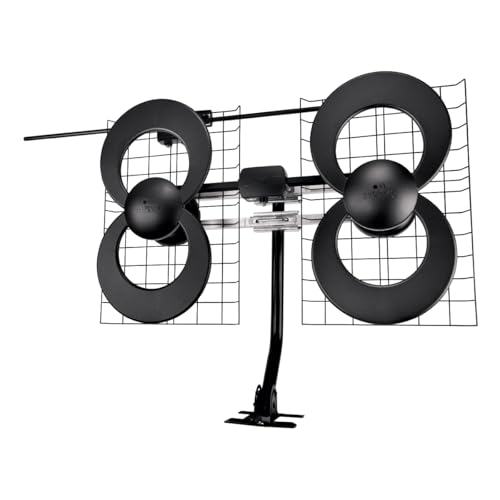




Write Your Review
No reviews yet. Be the first to share your experience!