

A power outage, a campsite without a mains outlet, or a room far from a wall socket can make battery-powered TV viewing appealing. The right setup depends on whether the television has a built-in battery, accepts low-voltage DC power, or needs an external power station that supplies household-style AC power. Those options aren’t interchangeable, and a battery designed for a headset or remote won’t run a standard television.
For how to power a tv with a battery, start with the label or manual for the television, then match the power source to its voltage, connector, and expected runtime. The products listed below include a portable TV with an integrated rechargeable battery, a replacement battery for TV listening headsets, and rechargeable AA cells. Each serves a different purpose. If you are planning an outdoor setup, our guide to outdoor smart TVs covers a related question: whether the display itself is suited to the installation environment.
Product Shortcode

Pros
- Delivers up to four hours of uninterrupted television audio on a full charge
- Eco-friendly rechargeable NiMH cell replaces single-use disposable batteries
- Exact fit for TV Ears Original, Digital, and 5.0 television headset models
- Revitalizes existing TV audio headsets without the expense of a brand-new system
Cons
- Four-hour runtime requires docking between extended all-day TV viewing sessions
- Rechargeable battery capacity naturally diminishes after roughly one year of daily use
The TV Ears Replacement Battery is a dedicated rechargeable power source engineered specifically for TV Ears Original, Digital, and 5.0 television audio headsets. As modern flat-screen 4K smart TVs and OLED displays feature increasingly compact, downward-firing speakers, speech intelligibility often suffers during action movies and dialogue-heavy broadcasts. Rather than cranking up living room soundbars to overwhelming volumes, TV Ears systems send clear voice audio directly to a personal listening headset, and this authentic replacement cell keeps that wireless connection performing reliably.
This battery is best suited for seniors, apartment dwellers, late-night movie fans, and bedroom TV viewers who rely on private audio solutions. It works exceptionally well in busy households where one viewer requires amplified dialogue for evening news or football games while other family members study or sleep nearby. Cord-cutters and streaming fans who watch television late into the night will appreciate having dependable power to avoid disturbing neighbors or roommates.
Based on product specifications and user feedback, the Nickel Metal Hydride cell provides up to four hours of continuous operation after a complete charge cycle. Consistent electrical output is vital for the headset's internal voice clarification circuitry, as aging batteries can cause crackling, reduced volume, or signal drops during critical TV scenes. While four hours easily accommodates an evening film double feature or an entire live sporting event, heavy viewers who stream shows all day may want to keep a secondary battery rotating in the charging dock.
Installation is straightforward and requires no tools. The battery snaps directly into the headset housing, matching the original factory dimensions without adding awkward bulk or neck strain. Once installed, it recharges effortlessly via the standard TV Ears transmitter charging cradle, ensuring your television listening setup remains organized and ready for daily use.
Like all rechargeable television accessories, internal chemical cells degrade over time, with manufacturers noting an expected operational lifespan of approximately one year under typical daily charging conditions. For viewers whose current television listening headset no longer holds a charge through an entire movie, this replacement battery offers an economical way to restore performance without purchasing an entirely new wireless audio setup.
A fresh battery plays a direct role in maintaining optimal audio performance for television listening headsets. When rechargeable cells begin to degrade, viewers often experience decreased volume ceiling, faint background hiss, or unexpected dropouts during dialogue scenes.
By restoring consistent power delivery, this replacement cell helps the headset internal voice clarification circuitry separate spoken dialogue from background musical scores and explosions on modern 4K streaming platforms. This makes television audio significantly clearer for sports commentary, late-night drama series, and daily news programs.
Replacing the battery requires only seconds: gently pull the depleted green battery from the base of the TV Ears headset and slide the new cell into the keyed slot until securely seated. No wiring, screws, or specialized tools are necessary.
To maximize battery health and lifespan, place the headset into the dedicated TV Ears charging dock after each viewing session. Allowing the battery to complete a continuous charge cycle helps maintain the full four-hour runtime for everyday movie watching and sports broadcasts.

Pros
- Long 4+ hour battery life for untethered use away from power
- Versatile input options: HDMI, USB, AV, and headphone jack cover most devices
- Compact and lightweight design with built-in stand for easy placement anywhere
- Dual antennas provide reliable over-the-air digital TV reception
Cons
- Screen resolution is 1080p, not 4K, so image sharpness is limited for close-up viewing
- LCD panel has narrow viewing angles and moderate brightness, best used in shaded or indoor settings
- No smart TV platform built-in; requires an external streaming device for apps like Netflix or Hulu
The Tyler 14" Portable TV is a practical little screen designed for people who need entertainment on the move. Unlike big-screen home theater sets, this compact LCD monitor focuses on portability and versatility. It comes with a built-in rechargeable battery that promises over 4 hours of playback, making it a solid companion for camping trips, RV life, long car rides, or even during power outages at home. Whether you're tailgating before a game or just want a small TV for the kitchen counter while cooking, this unit fits the bill.
Picture quality is what you'd expect from a budget-friendly 14" LCD panel. The 1080p resolution delivers decent sharpness for its size, though colors won't pop like an OLED or QLED set. Contrast is adequate for casual viewing in dimmer settings, but bright sunlight will wash out the screen. The built-in digital tuner and dual antennas do a good job picking up over-the-air HD channels, so you can catch local news or sports without any subscription. The FM radio is a nice bonus when TV signals are weak.
Connectivity is where this little TV shines. It offers HDMI, USB, dual AV inputs (RCA), a headphone jack, and even VGA. You can plug in a Fire Stick or Roku for streaming Netflix and YouTube, hook up a DVD player for movie night, or connect a gaming console for some portable play. It also works as a secondary computer monitor via HDMI or VGA, which is handy for students or remote workers in tight spaces. The included remote and built-in stand make setup quick and easy.
Build quality is solid for its price point - the plastic casing feels durable enough for travel, and the screen has a basic anti-glare coating. The built-in speaker is small and lacks bass, so dialogue can sound tinny. For better audio, use the headphone jack with earbuds or connect external speakers via the audio output. Battery life holds up well in real-world use; according to user feedback, you can easily get through a movie or a few episodes of a show on a single charge.
There are some limitations to keep in mind. This is not a smart TV, so you'll need an external streaming device for apps. The viewing angles are narrow, so picture quality drops if you're off to the side. And while the 1080p resolution is fine for a 14" screen, it won't satisfy those used to 4K content. If you're a home theater enthusiast looking for deep blacks or HDR performance, this isn't the TV for you. But if you need a portable, battery-operated screen for travel, camping, or a dorm room, the Tyler 14" is a very capable choice.
Overall, this portable TV is best suited for budget-conscious shoppers, outdoor enthusiasts, RV owners, and parents looking for a small TV for kids' rooms or car rides. It's also a practical gift for college students or anyone who spends time in spaces where a traditional TV won't work. While it can't replace a full-sized living room set, it fills a specific niche for on-the-move entertainment with excellent connectivity and battery freedom.
Pros
- Cost-effective reusable power for smart TV remotes, gamepads, and streaming remotes
- Rechargeable up to 1,200 cycles, significantly lowering long-term battery expenses
- Stable voltage output ensures smooth voice control and menu responsiveness on smart TVs
- Eight-pack provides ample spares for multiple remotes, gaming gear, and outdoor accessories
Cons
- Operates at 1.2V nominal voltage, which may trigger low-battery warnings early on select 1.5V-calibrated TV remotes
- Requires a separate Ni-MH battery wall charger if not being recharged via solar units
- May require a full charge cycle out of the box before delivering maximum runtime
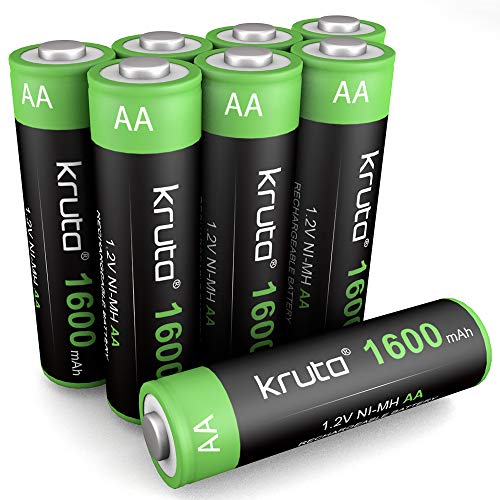
The Kruta 1600mAh Ni-MH Rechargeable AA Battery pack is an essential home entertainment accessory designed to keep your smart TV remotes, streaming sticks, soundbar controllers, and wireless gaming peripherals running smoothly. For American homeowners, apartment renters, cord-cutters, and home theater enthusiasts, keeping a dependable set of rechargeable cells on hand eliminates the annoyance of a dead remote right before a Friday family movie night or an intense gaming session. This 8-pack is especially well suited for families with kids who burn through disposable batteries playing console games, as well as streamers who rely heavily on backlit or voice-enabled remotes.
Navigating modern 4K OLED, QLED, and Mini-LED smart TV platforms requires responsive remote inputs, especially when accessing deep picture settings for Dolby Vision, HDR10+, or fine-tuning local dimming and contrast levels. Voice search features on Google TV, Roku TV, Fire TV, webOS, and Tizen platforms can drain conventional batteries quickly due to continuous microphone transmission. Based on product specifications, the 1600mAh capacity of these Kruta cells provides long-lasting power to keep voice remotes quick and lag-free, helping ensure you never lose quick access to Netflix, Prime Video, Disney+, or live sports broadcasts.
For console gamers and PC enthusiasts connecting systems to high-refresh-rate 120Hz gaming TVs, input responsiveness is crucial. When wireless controllers or media remotes experience voltage sag, users can encounter input latency or sporadic disconnections during critical multiplayer matches. These Ni-MH batteries maintain steady voltage discharge across extended sessions, supporting low input lag and seamless command execution. Whether you are adjusting audio modes on a Dolby Atmos soundbar or toggling VRR and ALLM settings on your TV menu, having steady battery power prevents interruptions during heated gameplay.
In terms of build quality and practicality, Kruta utilizes standard AA form-factor cells built with nickel-metal hydride chemistry that withstands up to 1,200 recharge cycles. The wide operating temperature range of -4 degrees to 140 degrees Fahrenheit also makes them adaptable for outdoor TV setups, patio string lights, and sunrooms. For everyday living room handling, having eight batteries means you can keep four actively powering your primary smart TV clicker and console controller while keeping four fully charged and ready in a drawer or on a standard wall charger for instant swapping.
A realistic consideration for prospective buyers is that Ni-MH batteries output 1.2 volts compared to 1.5 volts found in single-use alkaline cells. While most modern smart TV remotes and gaming accessories handle 1.2V without issue, some sensitive devices may display a low-battery indicator prematurely. Additionally, you will need a compatible Ni-MH smart charger to replenish them indoors. Overall, for budget-conscious streamers, sports fans hosting Super Bowl watch parties, and movie lovers wanting a greener living room power solution, this Kruta AA 8-pack represents a sensible, high-value addition to any home entertainment system.
Modern living rooms are filled with battery-dependent entertainment gear, ranging from smart TV clickers and soundbar wands to wireless gamepads and streaming media remotes. These Kruta AA rechargeable cells fit smoothly into standard AA compartments across multiple brands and peripheral devices, making it simple to consolidate your household battery rotation.
Because features like voice-activated microphones, controller rumble packs, and backlit remote buttons draw higher continuous power, switching away from throwaway alkaline batteries provides tangible long-term value. Keeping a fresh set of charged cells ready ensures that binge-watching sessions, holiday movie marathons, and late-night gaming tournaments stay completely uninterrupted.
Battery power for a television: what works and what does not
A battery can power a television if the power source supplies the type of electricity the TV expects, at the required voltage and with adequate capacity. A portable TV with its own rechargeable battery is the simplest arrangement because its battery and charging system are built into the set. For many conventional televisions, an external power station with an AC outlet is the practical route, provided its output is appropriate for the TV and its battery has enough usable capacity for the planned viewing time.
Do not assume that any battery with a USB port, a 12-volt label, or a high capacity can run a TV. The television’s power adapter and rating determine what it needs, while the battery source determines what it can provide. A mismatch can prevent operation or damage equipment. Check the TV and power-source manuals, and do not open the TV or modify its internal power supply.
Start with the TV power label, not the battery advertisement
Find the television’s input rating on its rear label, power adapter, or documentation. It may list AC voltage and frequency, or DC voltage and polarity, along with current or power. Use the TV’s actual power requirement as the basis for choosing a source. If the label gives volts and amps rather than watts, multiplying voltage by current gives a rough input-power figure, but the manufacturer’s stated power rating is the better reference when available.
Next identify the connector and whether the TV expects alternating current or direct current. A household AC adapter may convert wall power into DC for the television; that does not mean an arbitrary DC battery can safely replace the adapter. Voltage, polarity, connector dimensions, and current capability all matter. If any marking is unclear, contact the TV manufacturer or a qualified service provider instead of experimenting with cables.
Also separate the television’s load from its accessories. A streaming stick, antenna amplifier, game console, soundbar, or router can draw power separately, and their combined use changes the runtime of a battery station. A TV’s USB port may be intended for limited accessory power or media playback rather than supplying the television itself. Follow the port’s stated purpose and rating rather than treating it as a general power input.
Choose between a built-in battery, DC source, and AC power station
A TV with an integrated rechargeable battery needs the least setup: charge it according to its instructions, then use it within the manufacturer’s operating guidance. The Tyler 14” Portable TV LCD Monitor 1080P is listed with a built-in rechargeable battery, more than four hours of play time in its product description, and a 12-volt charging cord. Actual runtime can vary with conditions and use, so treat the advertised duration as a reference rather than a guarantee for every viewing session.
A DC battery connection may be suitable only when the TV specifically accepts the battery’s voltage and connector arrangement. Some portable sets provide a compatible car-power cord, but that does not establish compatibility with every battery, vehicle socket, or adapter. Check the exact device documentation and accessories. Never force a connector or improvise polarity, and don’t rely on a generic adapter simply because it plugs in.
An AC power station can be considered for a television that normally uses a standard wall plug. Its AC output must be rated for the TV’s demand, and its usable energy must cover the intended duration. Check the station’s continuous output rating and any limits in its instructions. A peak or surge rating is not the same as the power it can provide continuously, and an inverter can consume some stored energy while converting battery power to AC.
For a small, compact installation, an integrated-battery TV may avoid the extra equipment and conversion losses of a separate station. For a larger set, a compatible power station is often the relevant category to investigate, but actual runtime will depend on the set and source ratings. The supplied products do not include a general-purpose power station or a battery intended to power a standard full-size television, so they should not be presented as a complete solution for every TV.
Estimate runtime before relying on battery power
Battery capacity and TV consumption provide a useful first estimate. If capacity is stated in watt-hours, divide that figure by the TV’s approximate watts to estimate hours in an idealized calculation. For example, a source rated at 200 watt-hours and a 40-watt load gives a simple upper-bound estimate of five hours. Real operation can be shorter because conversion losses, battery protection limits, changing screen brightness, and other connected devices affect the usable energy.
When a battery is rated in amp-hours, that number alone doesn’t establish how long a TV will run. Amp-hours describe charge relative to a particular voltage, so compare watt-hours where possible or calculate energy from voltage multiplied by amp-hours. A battery’s nominal voltage and usable capacity may differ from what a product’s headline number suggests. Use the manufacturer’s specifications and avoid treating capacity labels as directly comparable when voltage or test conditions differ.
Account for the whole viewing setup rather than only the panel. A streaming device and wireless router may require their own power, while a built-in tuner can receive broadcast TV without an internet connection if a usable antenna signal is available. An antenna itself doesn’t provide power to the display. If you are evaluating an antenna for reception during an outage, our indoor amplified antenna overview is relevant, but an amplifier may need separate power according to its design.
Use a conservative runtime estimate
Plan below the ideal calculation rather than expecting the battery to reach its full nameplate capacity under every load. A power station’s usable AC energy is normally less than the battery’s stored energy because conversion and operating overhead take a share. Manufacturers may publish estimates for particular loads, but those should not be assumed to describe your TV exactly. Leave a reserve for shutdown, changing loads, and uncertainty instead of scheduling viewing right to the theoretical limit.
Screen settings can affect consumption, but don’t assume that turning brightness down will yield a precise runtime increase unless the device maker provides that data. Picture mode, content, connected equipment, and automatic brightness features can change demand. For planning, use the TV’s stated consumption if available and the power station’s guidance for AC loads. If the available information is incomplete, treat any calculation as an estimate rather than a promised number of hours.
Test the intended setup in a safe, supervised setting before depending on it for a long trip or an emergency. Note the battery level before and after a representative period, while using the accessories and settings you expect to use. This gives a more practical estimate for that particular combination, without turning a single trial into a guaranteed result. Do not continue operating equipment that becomes unusually hot, emits an odor, makes unexpected noises, or displays a warning; follow the manufacturer’s instructions.
What the listed battery products actually power
The three products in the shortcode are not three equivalent ways to power a television screen. One is a headset replacement battery, another is a portable TV with a built-in battery, and the third is a pack of rechargeable AA cells. This distinction matters because product titles can include terms such as TV or television even when the battery is meant for an accessory. Match the product to the device it is designed to serve.
Portable TV battery versus headset battery
The Tyler portable set is the only listed option described as a television with its own rechargeable battery. Its product information also lists HDMI, USB, RCA, a digital tuner, FM radio, and a car charging cord. Those connections describe possible functions, not a promise that every connected device can run from the TV’s battery. Check each accessory’s own power needs and the TV’s manuals before assembling a portable system.
The TV · Ears Replacement Battery Original is described as a rechargeable NiMH replacement for compatible TV Ears headsets, not as a television power source. The product description states up to four hours of headset operation on a full charge and notes that battery life varies with use and charging. That runtime applies to the headset context described by the manufacturer. It does not indicate that the battery has the voltage, capacity, or connector required to power a TV.
Replace a headset battery only after confirming the headset model and following the maker’s replacement guidance. The supplied product information recommends speaking with a TV Ears technician before replacing the battery. That is a device-specific recommendation, not an instruction to open a television. A headset’s small rechargeable pack and a TV’s power system serve very different electrical loads.
Why rechargeable AA cells do not run a regular TV
The Kruta AA batteries are rechargeable 1.2-volt NiMH cells listed for uses that include remotes and other small devices. Their appearance in a product list about TV battery power doesn’t mean they can supply a television directly. A typical TV requires a power input and energy supply that are different from what a loose AA cell provides. Do not put individual cells into a television or connect them using improvised wiring.
These cells may be relevant to a remote if the remote accepts AA batteries and its instructions allow rechargeable cells of the specified type. The product description says the cells can be charged in solar lights or with a qualified universal charger. That charging information concerns the AA batteries, not the TV. Use a charger compatible with the cell chemistry and follow its directions; a solar light’s charging circuit is not a substitute for a television power supply.
For a full-size television, the practical lesson is to avoid confusing accessory batteries with display power solutions. A remote can work while the TV remains unpowered, and a headset can provide audio without supplying energy to the screen. If a product listing doesn’t explicitly identify the TV model or electrical requirements it supports, don’t assume compatibility from its title. Confirm specifications before buying a battery or adapter.
Safe connection and operation during an outage or trip
Keep the power connection within the equipment’s intended use. Use the supplied or manufacturer-approved adapter and cables, and connect only outputs that match the TV’s documented input. Do not cut, splice, or modify a power cord, bypass protection, or route household power through a homemade battery connection. If a power station’s output type or rating is uncertain, consult its manufacturer before connecting the television.
Battery stations and televisions need sensible placement. Follow each product’s ventilation and environmental guidance, keep openings unobstructed, and protect equipment from moisture unless it is specifically rated for the conditions. An indoor television should not be assumed safe outdoors just because a battery makes it portable. For any outdoor placement, verify that the TV and every power component are intended for that setting.
Battery charging also deserves attention. Charge the TV or power station using the specified charger and conditions, and do not leave equipment in locations outside the manufacturer’s temperature guidance. Avoid damaged cables, swollen batteries, or equipment that behaves abnormally. Stop using a suspect battery and contact the manufacturer for appropriate handling instructions rather than attempting to repair a battery pack yourself.
During a household outage, never connect a portable power station to a home’s wiring or wall outlet as a way to energize circuits unless a properly installed transfer arrangement and qualified professional guidance are involved. A TV can be connected directly to a suitable power station’s designated output according to both manuals. Keep the setup away from children and trip paths, and do not daisy-chain power devices in ways their manufacturers prohibit.
Choose a setup based on the TV you own
For the Tyler portable TV, the integrated rechargeable battery is the direct listed route, with its stated runtime treated as an estimate and its supplied charging method followed. For a conventional television, read the power label and compare it with a suitably rated power station or another manufacturer-approved source. A remote that uses AA cells needs compatible cells for the remote only, while the TV · Ears battery belongs to its compatible headset. Those distinctions prevent a common mismatch between an accessory battery and a display power requirement.
Before relying on the setup, confirm that the TV starts normally, the source remains stable, and the battery’s status indicator behaves as described in its manual. Check that any streaming or antenna equipment has its own appropriate power, and estimate runtime with the entire intended load in mind. If the connection requires an adapter whose voltage, polarity, or rating you cannot verify, stop and ask the equipment manufacturer. A compatible, documented power path is more important than improvising with a battery that merely appears convenient.


Write Your Review
No reviews yet. Be the first to share your experience!