


Many home theater owners buy modern ultra-high-definition screens expecting pristine native resolution across every channel, only to find standard cable and over-the-air feeds look unexpectedly soft. Traditional network television continues to send signals primarily in 720p or 1080i, which creates significant confusion about what tv shows are broadcast in 4k on regular linear channels. Understanding the structural differences between legacy transmission formats and modern digital delivery explains why true ultra-high-definition programming remains rare on standard daytime and primetime schedules. Modern displays bridge this gap using internal hardware processors that upscale incoming lower-resolution feeds, while external hardware like over-the-air HDTV antennas paired with NextGen tuners begins to unlock high-dynamic-range feeds in select metropolitan regions.
While episodic dramas and comedies rarely air in native resolution over standard cable channels, live sports and streaming platforms have stepped in to supply vibrant 4K HDR content. Viewers searching for true ultra-high-definition entertainment will discover that specialized satellite channels, live event feeds, and subscription services carry the vast majority of sharp, high-bitrate productions. Pairing a capable television display with modern streaming hardware ensures you access legitimate resolution upgrades rather than artificial scaling artifacts. Looking into network transmission standards, streaming upgrades, and device capabilities will help you pinpoint exactly where native ultra-high-definition entertainment lives.
Pros
- Crisp 4K HDR streaming performance that revitalizes older 4K flat panels and bedroom monitors
- Intuitive Google TV interface organizes watchlists and recommendations across your existing subscriptions
- Ergonomic voice remote with dedicated volume, power, and Google Assistant controls
- Simple plug-and-play HDMI setup works seamlessly with living room, dorm, or basement televisions
Cons
- Requires an external power outlet rather than standard TV USB ports for stable 4K playback
- Limited onboard storage can fill quickly if you install dozens of heavy streaming apps
- Included voice remote is compact and can easily slip between living room couch cushions
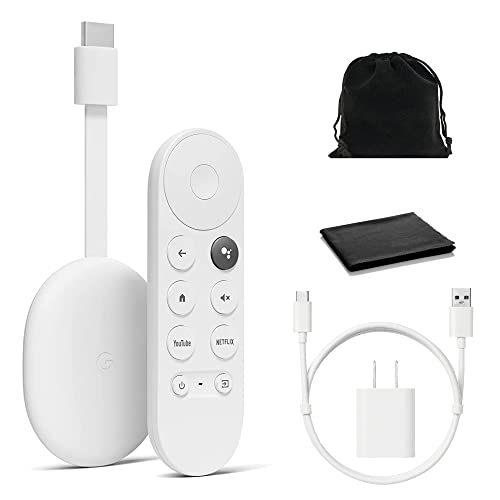
The Google Chromecast with Google TV 4K is a dedicated external streaming player built to deliver high-resolution entertainment straight to any television equipped with an HDMI port. For American homeowners and apartment renters who own older displays with slow built-in software, this compact device provides a clean way to modernize your viewing setup without purchasing an entirely new television set. It caters equally well to cord-cutters tired of clunky cable boxes, busy families organizing kids' watchlists, and movie lovers who want high-fidelity streaming in their living room, bedroom, or basement recreation space.
Visual output is a notable strength of this streaming dongle. Based on product specifications, it delivers crisp ultra-high-definition resolution at up to 60 frames per second alongside major high-dynamic-range formats such as HDR10, HDR10+, and Dolby Vision. When paired with a compatible 4K HDR panel, viewers will notice rich black levels, balanced contrast ratios, and authentic color saturation during cinematic scenes. Fast-paced sports broadcasts and live action gaming streams also benefit from smooth frame pacing, helping reduce motion judder on modern 60Hz and 120Hz displays during Sunday football games or high-stakes video game tournaments.
Where this media player truly stands out is its software experience. Unlike older casting adapters, Google TV brings a full-fledged on-screen interface that pulls together content from Netflix, Disney+, Prime Video, YouTube TV, Apple TV, and numerous other apps onto a single homepage. Instead of jumping between individual services, your home screen provides tailored suggestions based on what you already watch. The included voice remote features a responsive Google Assistant button, letting you search for specific actors, look up weather updates, or jump directly into live TV streams simply by speaking into the microphone.
Hardware practicality is another big advantage for clean home theater aesthetics. The device measures just a few inches in length and features a flexible HDMI tail that easily plugs into tight recessed ports on wall-mounted televisions. It supports dual-band Wi-Fi for steady 4K data transfers, as well as Bluetooth connectivity for pairing wireless gaming controllers or Bluetooth headphones for late-night viewing after the kids have gone to bed. The remote also includes programmable infrared controls to manage the volume and power of your existing TV or soundbar, eliminating the need to juggle multiple remotes on the coffee table.
Despite its extensive streaming capabilities, prospective buyers should keep a few practical limitations in mind. The Chromecast 4K requires continuous power from the included wall adapter and USB-C cable, meaning you cannot reliably power it from low-wattage USB ports on the back of your television. In addition, internal storage space is on the modest side, which means users who download a high volume of gaming titles or specialized apps may eventually need to manage storage. The petite remote control can also be slick to hold and easily misplaced in family living rooms.
For everyday viewers seeking a dependable, affordable way to elevate their home entertainment, the Google Chromecast with Google TV 4K hits a sweet spot between performance and usability. It provides crisp 4K HDR picture quality, outstanding voice navigation, and unified watchlist management that simplifies family movie nights, weekend sports streaming, and weeknight binge-watching. If you want to bypass outdated smart TV platforms and enjoy smooth streaming across all your favorite subscriptions, this device is a reliable and practical addition to any living room setup.
The Google TV platform unifies streaming apps into a centralized feed, letting you browse personalized movie and television recommendations without jumping in and out of different services. Users can create individual profiles for adults and children, ensuring parental controls remain active while keeping personalized recommendations tailored to each family member.
Built-in Google Assistant turns your remote into a voice search tool, capable of tracking down titles by genre, director, or famous quote. Beyond entertainment search, the remote can also answer everyday questions, display linked Google Nest doorbell feeds on your TV screen, and adjust compatible smart home lights for movie night.
Getting started takes only a few minutes. Plug the integrated HDMI connector into an open port on your TV, connect the included USB-C cable to the provided power adapter, and plug it into a standard wall outlet. Once your television input is set to the correct HDMI port, on-screen prompts guide you through pairing the remote.
Using the Google Home app on an Android or iOS mobile phone streamlines the initial Wi-Fi setup and Google account login. The setup process also automatically detects your television brand to configure the remote control buttons for TV power and soundbar volume control.
Understanding 4K Television Broadcasts and Where to Find True Ultra-High Definition Content
The reality of modern television distribution often contradicts the marketing printed on ultra-high-definition packaging. While display panels offer 3840 by 2160 pixels of native resolution, conventional linear television broadcasts across cable, satellite, and terrestrial antennas remain locked in legacy formats. Viewers asking what tv shows are broadcast in 4k must distinguish between traditional scheduled broadcasts and digital internet-delivered streams to locate genuine high-resolution material. Taking a closer look at network distribution, video bandwidth limits, and display processing clarifies why true broadcast ultra-high definition remains a specialized viewing tier.
The Linear Broadcast Dilemma: Why Network Cable and Airwaves Lag in 4K
Broadcast television networks designed their distribution backbones around legacy standards established during the digital transition decades ago. Major networks like CBS, NBC, ABC, and FOX distribute national feeds formatted exclusively in either 720p progressive or 1080i interlaced video. Upgrading an entire transmission chain from field cameras and control room production switchers to affiliate satellite uplinks requires immense infrastructure capital. Broadcasters also face severe bandwidth limits over wireless radio spectrum, where local stations must divide limited digital bandwidth among multiple subchannels.
Cable television operators face similar spectrum bottlenecks within their physical coaxial infrastructure. Traditional QAM cable tuners allocate a fixed frequency width to each channel, forcing providers to heavily compress video streams to fit hundreds of channels onto a single line. Delivering uncompressed or lightly compressed native ultra-high-definition signals to millions of subscribers would consume substantial bandwidth that providers prefer to allocate to high-speed broadband internet. As a result, standard primetime sitcoms, procedural dramas, and evening news broadcasts do not air in native ultra-high definition on linear channel guides.
Which TV Shows and Live Events Actually Air in Native 4K?
Linear 4K broadcasts do exist, but network programmers reserve them almost entirely for premier live sports and marquee entertainment specials. Satellite operators like DirecTV and Dish Network maintain dedicated event channels that occasionally carry high-profile baseball games, college football matchups, and premier golf tournaments. Cable subscribers using premium provider set-top boxes can occasionally access select live broadcasts, such as international soccer matches or seasonal playoff games. Scripted weekly television series, however, are essentially nonexistent on these linear feeds, as networks prioritize live spectacles where visual fidelity delivers immediate promotional value.
Even when a network advertises an event in ultra-high definition, production pipelines frequently utilize an upscaled workflow rather than end-to-end native capture. Many live sports broadcasts rely on 1080p high-dynamic-range production trucks on-site, which operators then convert to 4K resolution before transmitting the feed to cable or satellite hubs. This production method still yields substantial picture improvements over standard 720p broadcasts by reducing digital artifacts and expanding dynamic contrast. Sports fans viewing these high-action events often rely on high-performance sports televisions capable of managing swift camera pans and preserving bright stadium highlights without backlight stutter.
ATSC 3.0 and NextGen TV: The Future of Over-the-Air High-Dynamic Range
Terrestrial over-the-air broadcasting is undergoing an evolution through the rollout of ATSC 3.0, commercially branded as NextGen TV. Unlike the aging ATSC 1.0 standard, NextGen TV utilizes modern internet protocol encapsulation and efficient HEVC encoding to broadcast data over existing antenna frequencies. This updated architecture provides theoretical capacity for native 4K signals alongside advanced audio formats like Dolby Atmos. In practice, however, local television stations currently prioritize broadcasting 1080p progressive signals enhanced with high dynamic range rather than native 2160p resolution.
Broadcasters choose 1080p HDR for NextGen transmissions because it strikes a practical compromise between image quality and bandwidth efficiency. High dynamic range provides a far more noticeable visual upgrade to the average viewer than higher pixel density alone, especially at standard living room seating distances. The improved contrast ratio and expanded color palette give broadcast imagery immediate visual depth without overburdening local station transmitters. Viewers hoping to access these NextGen signals need either an internal ATSC 3.0 television tuner or an external digital converter box connected to a standard antenna.
Streaming vs. Linear Broadcast: Where Episodic 4K Television Actually Thrives
Viewers seeking pristine episodic television shows must shift their focus from traditional linear cable guides to subscription video-on-demand services. Platforms such as Netflix, Amazon Prime Video, Apple TV+, Max, and Disney+ produce nearly all their flagship original series in native 4K with advanced high dynamic range. Popular episodic shows like historical dramas, science fiction series, and high-budget fantasy epics bypass broadcast frequency constraints completely by streaming over high-speed broadband connections. This digital distribution pipeline allows content creators to preserve intricate shadow details, film grain, and wide color gamuts that broadcast television compression typically strips away.
Live television streaming platforms also offer dedicated avenues for live ultra-high-definition channels that bypass coaxial cable hardware. Services such as YouTube TV and Fubo provide select live sports and special network events in 4K through premium subscription tiers. Viewers outfitting their entertainment spaces with dedicated 4K streaming displays can seamlessly navigate between live network feeds and on-demand content libraries. Utilizing these modern streaming applications remains the most reliable method for household viewers to experience consistent ultra-high-definition programming.
Broadcast HDR Formats: Demystifying HLG, HDR10, and Dolby Vision on Live Feeds
High dynamic range technology plays a crucial role in modern broadcast clarity, but live television handles color metadata differently than recorded streaming media. Linear broadcasters and live event producers frequently adopt Hybrid Log-Gamma, commonly known as HLG, as their preferred dynamic range standard. Developed collaboratively by the BBC and NHK, HLG combines standard dynamic range and high dynamic range signals into a single unified video stream. This backwards compatibility allows older standard screens and modern ultra-high-definition panels to decode the exact same broadcast transmission without visual corruption.
Streaming services, in contrast, rely predominantly on HDR10 or proprietary Dolby Vision dynamic metadata to adjust brightness and color frame-by-frame. HDR10 provides static metadata that establishes fixed lighting parameters across an entire program, while Dolby Vision dynamically optimizes specular highlights for each specific scene. Live HLG broadcasts lack dynamic metadata, meaning your display must manage peak brightness and tone mapping using internal hardware algorithms. Understanding this distinction helps explain why a live sports broadcast in 4K HLG may exhibit softer peak highlights compared to a mastered streaming drama using Dolby Vision.
Hardware Requirements: Streaming Media Players and Signal Passthrough
Accessing modern ultra-high-definition television programming requires hardware capable of decoding modern compression codecs and managing high-speed digital handshakes. An external streaming adapter like the Google Chromecast with Google TV illustrates how dedicated streaming components bridge the divide between linear and on-demand viewing. This streaming player connects directly to an available television HDMI input, delivering native support for 4K video resolution alongside dynamic HDR formats. Integrated voice navigation via the Google Assistant remote lets viewers search across multiple subscriptions, including YouTube TV live feeds, to locate available high-resolution events.
Beyond platform navigation, proper hardware implementation requires verifying your television HDMI port specifications and cable bandwidth capabilities. Transmitting a 4K video signal at 60 frames per second with full HDR color requires an HDMI port rated for at least 18 gigabits per second, matching HDMI 2.0 or modern HDMI 2.1 specifications. Connecting your media player to an older secondary HDMI 1.4 port will restrict your signal to standard dynamic range or reduce your frame rate to a juddery 30Hz. Ensuring your streaming hardware connects to an enhanced HDMI port allows uninterrupted transmission of high-bitrate live streams and audio passthrough.
Cable Provider Equipment Checks and Resolution Output Settings
Many households with 4K televisions fail to realize that their cable or satellite provider equipment defaults to legacy resolution standards unless manually configured. Cable set-top boxes frequently ship with their display resolution locked to 1080i or 720p to guarantee compatibility with older television sets. Navigating your provider device video settings menu and manually selecting 2160p or 4K output ensures your box transmits any incoming high-resolution feed without internal downscaling. Performing this check eliminates unnecessary resolution bottlenecks before the video signal ever reaches your television panel.
High-bandwidth digital content protection handshakes, commonly known as HDCP 2.2 or HDCP 2.3, can also silently prevent 4K playback on cable boxes and streaming media devices. If an older audio-video receiver, soundbar passthrough port, or legacy switch box sits between your source and the television, the secure handshake may fail. When HDCP handshake errors occur, the source device automatically downgrades the video output to standard 1080p to prevent unauthorized recording. Connecting your provider box directly to a certified high-speed television input guarantees that copy protection protocols validate properly and allow native ultra-high-definition transmission.
Audio Synchronization and eARC Passthrough on Live 4K Streams
Upgrading to live 4K broadcast streams and NextGen TV transmissions also introduces new audio processing complexities that impact home theater setups. High-resolution sports feeds and live concert broadcasts frequently pair their visual stream with uncompressed multi-channel audio or immersive Dolby Atmos metadata. Transmitting this complex audio stream from a streaming player through your television to an external soundbar requires enhanced audio return channel connectivity, known as HDMI eARC. Standard optical audio cables and legacy ARC ports lack the necessary bandwidth to carry uncompressed high-bitrate surround sound, often resulting in audio downmixing.
Video processing latency during intensive 4K upscaling or high-dynamic-range tone mapping can also cause noticeable lip-sync discrepancies between audio and video tracks. Because the television image engine requires several milliseconds to process incoming broadcast frames, the video can lag behind incoming soundbar audio unless synchronized. Enabling eARC with automatic lip-sync correction inside your television audio settings allows the processor to delay the audio track by exact millisecond intervals. This automatic timing adjustment keeps actor dialogue and stadium commentary aligned with on-screen action across both live broadcasts and on-demand streaming series.
How TV Upscaling Engines Handle Standard 720p and 1080i Signals
Because traditional network broadcasts remain limited to lower resolutions, your television internal video processing engine performs the heavy lifting during everyday viewing. When an incoming broadcast signal delivers a 720p or 1080i frame, an onboard upscaler must calculate and interpolate millions of additional pixels to fill the 8.3-million-pixel 4K grid. Sophisticated modern televisions utilize machine learning algorithms and spatial noise reduction filters to analyze image edges and textures in real time. These processors actively distinguish between intentional film detail and unsightly broadcast compression artifacts like macroblocking or mosquito noise.
Upscaling quality varies significantly across display tiers, which directly influences how standard broadcast channels appear in your living room. Entry-level displays often rely on basic bicubic interpolation, which simply stretches incoming pixels across the screen and can make 720p sporting events appear noticeably soft and blurry. Premium television processors employ deep-learning databases that reconstruct fine edges, sharpen sports scoreboards, and eliminate color banding across flat stadium backgrounds. A high-end video engine cannot magically turn a compressed cable feed into a pristine 4K stream, but it prevents lower-resolution broadcasts from looking muddy on large-format screens.
Key Settings to Optimize Live Broadcasts and Streaming Feeds
Configuring your television internal menu settings correctly ensures that both low-resolution broadcasts and native high-dynamic-range feeds appear as clean as possible. Many factory-default television modes activate aggressive digital noise reduction and artificial edge sharpening, which introduce harsh ringing artifacts around broadcast text and actor silhouettes. Lowering your sharpness control to a neutral setting preserves natural edge contours and prevents exaggerated noise across compressed cable channels. You should also verify that your display HDMI input signal format is set to Enhanced, Deep Color, or full bandwidth so incoming streaming players can pass native 4K signals without chroma subsampling restrictions.
Motion handling represents another critical adjustment when toggling between standard 60Hz live broadcasts and cinematic 24p streaming television series. Factory presets routinely enable aggressive motion interpolation, colloquially known as the soap opera effect, which artificially smooths camera motion and ruins the cinematic pacing of narrative shows. While mild de-blur processing can help clarify fast-moving football or basketball broadcasts, disengaging aggressive de-judder options ensures that streaming dramas retain their original frame cadence. Selecting an accurate picture preset like Filmmaker Mode or Cinema Mode establishes balanced color temperatures, disabled motion smoothing, and natural gamma curves for both live events and prestige streaming series.
Navigating the modern television landscape requires recognizing that linear broadcast networks have largely ceded native ultra-high-definition delivery to streaming services and specialized live event broadcasts. While standard daytime cable feeds will continue relying on 720p and 1080i distribution for the foreseeable future, pairing robust video processing with capable streaming hardware unlocks exceptional viewing clarity. Equipping your home theater with versatile streaming media players and optimizing picture presets guarantees that your display extracts maximum visual performance from every broadcast signal, sports stream, and cinematic series you watch.




Write Your Review
No reviews yet. Be the first to share your experience!