
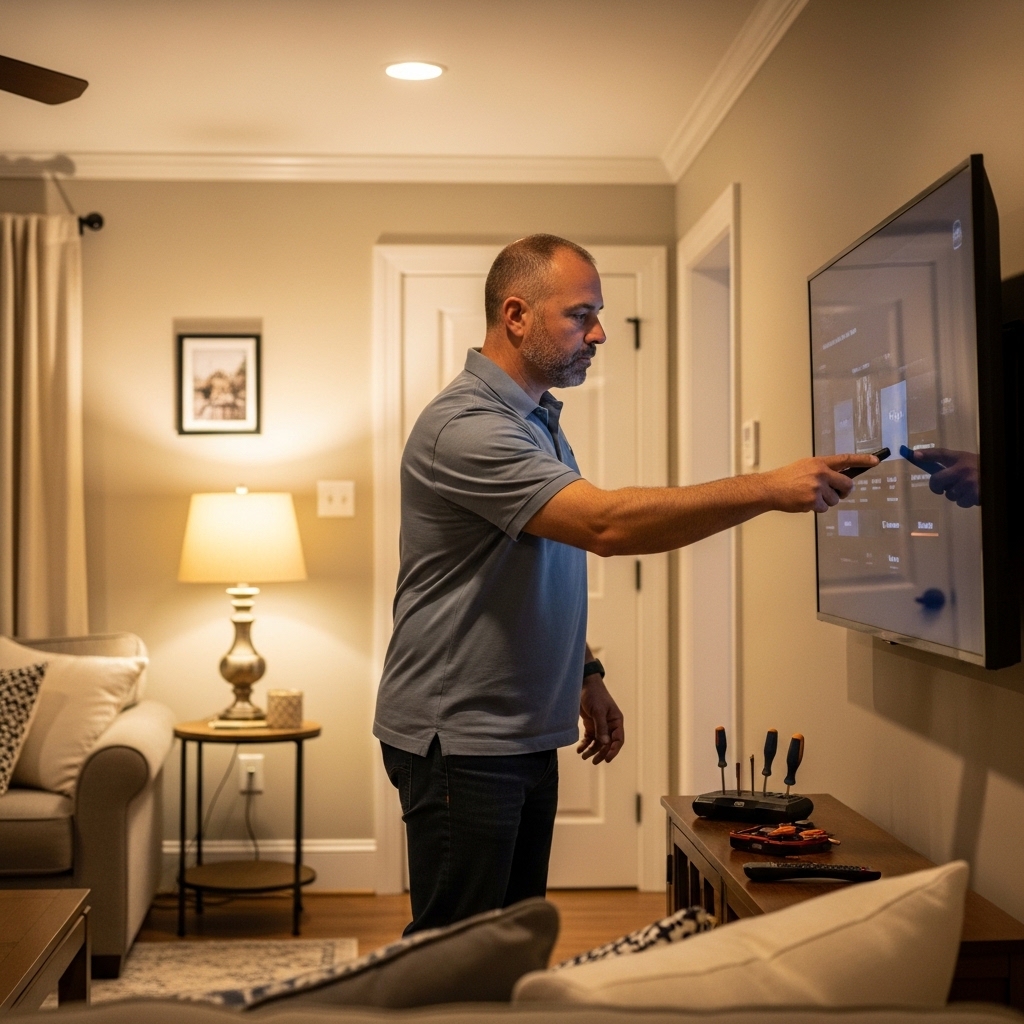

Ultra-high-definition home entertainment has advanced rapidly over the past decade, leaving many shoppers to wonder whether the leap beyond 4K is an active commercial reality. If you are asking does 8k tv exist, the straightforward answer is yes, as major manufacturers produce premium televisions sporting 7680×4320 native screen resolutions. These expansive screens pack roughly 33 million pixels into their panels, offering quadruple the pixel count of standard 4K displays. High-end panels utilize sophisticated backlights such as Mini-LED arrays alongside quantum dot color layers to maximize contrast and HDR performance. For high-motion broadcasts, selecting specialized Mini-LED TVs for sports shows how dense backlights keep fast action crisp across expansive screen surfaces.
While commercial hardware is readily available from industry leaders like Sony and Samsung, the daily viewing experience relies heavily on modern signal handling. Because native 8K video content remains scarce across major streaming platforms, these flagships utilize multi-neural network processors to upscale lower-resolution broadcasts, cable feeds, and 4K media in real time. Enthusiasts seeking extreme spatial clarity on 75-inch or 85-inch screens can indeed purchase these consumer displays today. However, understanding how visual acuity, seating distance, and connectivity interfaces shape actual performance helps determine if investing in an 8K display aligns with your living room needs.

Pros
- Extraordinary peak brightness and contrast control powered by thousands of precision Mini LEDs.
- Intelligent 8K upscaling ensures regular 4K movies and cable sports look remarkably crisp.
- Tailor-made for PS5 owners with Auto HDR Tone Mapping and rapid response times.
- Bundled BRAVIA CAM adds handy automated environmental tuning and video calling.
- Intuitive Google TV interface with extensive app availability and hands-free voice search.
Cons
- Native 8K content remains sparse across major consumer streaming platforms.
- Substantial panel weight and depth require sturdy furniture or heavy-duty wall mounting.
- Power consumption is higher than standard 4K LED and OLED alternatives.
The Sony Z9K Series 75-inch 8K Mini LED TV represents the flagship tier of living room and home cinema displays. Designed for dedicated home theater enthusiasts, tech enthusiasts, and serious console gamers, this high-end display brings together native 8K clarity and Mini LED illumination. Whether you are assembling a showcase media room in your house or upgrading a spacious suburban basement for big family movie nights, this flagship BRAVIA XR display provides the processing muscle and screen real estate to transform everyday entertainment into a full-scale cinematic event.
At the core of the viewing experience is Sony's Cognitive Processor XR working alongside the XR Backlight Master Drive. Based on product specifications, thousands of dense Mini LEDs are divided into tightly regulated local dimming zones, producing high peak brightness alongside deep blacks that rival OLED without the risk of permanent burn-in. Because true native 8K footage is still rare, the onboard XR 8K Upscaling is crucial. It intelligently reconstructs lost textures and details from 4K Blu-rays, live broadcast sports, and streaming media. Support for Dolby Vision, IMAX Enhanced, and Netflix Adaptive Calibrated Mode ensures that high dynamic range content retains accurate shadows and natural color saturation via XR Triluminos Pro.
Gamers, particularly those with a PlayStation 5 or Xbox Series X, will appreciate the integrated gaming performance. Equipped with HDMI 2.1 bandwidth, the display supports high-frame-rate 4K gaming at 120Hz, Variable Refresh Rate (VRR), and Auto Low Latency Mode (ALLM) with responsive input lag as low as 8.5ms. Sony includes exclusive PlayStation 5 optimizations such as Auto HDR Tone Mapping and Auto Genre Picture Switch, ensuring your console instantly dials in the ideal HDR parameters during high-speed action or quiet RPG exploration. A dedicated on-screen Game Menu lets you tweak crosshairs, motion blur reduction, and black equalizer levels on the fly without navigating deep settings.
Daily operation is powered by the Google TV ecosystem, granting quick access to services like Prime Video, Disney+, Apple TV, and YouTube. Built-in Google Assistant facilitates swift voice searching, while Apple AirPlay 2 makes sharing phone photos and video streams effortless. Sony also packs in the BRAVIA CAM, a magnetic top-mounted camera that enables gesture controls and video meetings. More importantly, Ambient Optimization Pro utilizes the camera sensor to identify where you sit in the room, automatically adjusting color temperature, brightness, and acoustic sound staging for dialogue clarity.
While the display sets a benchmark for illumination and visual punch, prospective buyers should consider a few practical elements. At 75 inches with an 8K Mini LED backlight array, the television is noticeably heavy and draws more power than conventional 4K displays. Wall installation demands a heavy-duty VESA mount anchored into wall studs, while tabletop use requires a deep, sturdy media console. For shoppers who demand ultimate brightness for sunlit living rooms, top-tier console gaming performance, and future-proof resolution for years of movie watching, the Sony Z9K stands out as a premier flagship investment.
For gaming setups, the Sony Z9K delivers a responsive experience engineered specifically to match current-generation consoles. With HDMI 2.1 inputs supporting 4K at 120Hz, Variable Refresh Rate (VRR), and Auto Low Latency Mode (ALLM), fast-paced first-person shooters and driving simulators run with fluid frame rates and minimal screen tearing. PlayStation 5 players gain unique advantages through Auto HDR Tone Mapping, which automatically selects the ideal HDR setup during initial console configuration.
The dedicated Game Menu interface provides swift access to tactical gaming tools. Players can quickly adjust VRR status, toggle motion blur reduction, or activate a black equalizer to spot competitors lurking in dark corners. Combined with low input lag, this television easily doubles as a high-performance tournament display for the ultimate basement gaming lounge.
Google TV serves as the central hub on the Z9K, aggregating personalized recommendations from all major streaming platforms such as Netflix, Max, Disney+, and Amazon Prime Video. Built-in hands-free Google Assistant allows users to search for actors, switch inputs, or dim connected smart lights without touching the remote, while Apple AirPlay 2 and Chromecast offer seamless mobile mirroring.
The included BRAVIA CAM introduces clever smart room integration. Ambient Optimization Pro recognizes viewer distance and room lighting, tuning the picture balance and acoustic positioning so that dialogue remains clear no matter where family members sit on the couch. It also supports simple gesture controls and large-screen video calls, making it a versatile tool for both entertainment and remote family gatherings.
Pros
- Pulls in crystal-clear uncompressed 1080p and 4K NEXTGEN TV signals without streaming compression artifacts
- Durable all-weather build equipped with a versatile 20-inch pivoting mount for outdoor or attic placement
- Dedicated Hi-VHF and UHF loop design broadens broadcast frequency reception for major networks
- Helps cord-cutters access free network television, local news, and live sports without eating into internet data caps
Cons
- Signal reception depends heavily on broadcast tower distance, regional topography, and heavy tree foliage
- Requires physical mounting and running a coaxial cable into your living room or home theater tuner
- Does not include an inline pre-amplifier for households located beyond standard reception ranges
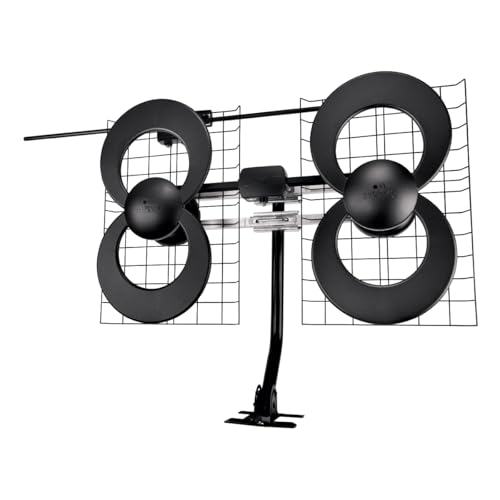
The Antennas Direct ClearStream 4V is a high-gain, multi-directional over-the-air television antenna engineered to feed crisp broadcast signals straight into modern smart displays. Tailored for cord-cutters, budget-conscious households, and sports enthusiasts, this antenna serves as a direct bridge to free local channels like ABC, CBS, NBC, FOX, and PBS. Whether you are pairing it with a high-end OLED display, a vivid QLED panel, or a budget-friendly living room LED TV, this hardware eliminates the continuous expense of cable television while taking full advantage of the internal digital tuner inside your television.
Where broadcast reception truly shines over standard cable or streaming apps is pure picture quality. Standard live streaming TV apps compress digital video, which often produces motion blur, digital artifacts, and streaming judder during fast-paced NFL or college basketball games. By pulling native uncompressed 1080p and ATSC 3.0 NEXTGEN TV signals out of the air, modern 4K and 8K televisions receive maximum color detail, sharp edge definition, and true black level integrity without internet bandwidth throttling. You also receive direct multi-channel Dolby Digital audio feeds, which deliver crisp dialogue clarity and punchy dynamics to your connected soundbar or home theater surround system.
From an engineering standpoint, the ClearStream 4V relies on four patented loop elements paired with dedicated Hi-VHF bars and dual rear mesh reflectors. The reflectors focus the reception field forward across a broad 43-degree beam angle, shielding the signal from interference bouncing off nearby houses or metal structures. The entire assembly measures 17.4 inches high by 27.8 inches wide, striking a balanced profile that mounts securely on an exterior roofline, chimney, exterior wall, or inside a spacious attic for discreet signal gathering.
Installation is relatively straightforward for homeowners and handy apartment dwellers with private balcony access. The package includes a sturdy 20-inch mast with a pivoting base that adjusts easily to sloped roofs or vertical walls, alongside all-weather mounting hardware. Once mounted and aimed toward your local regional broadcast towers, you simply connect standard RG6 coaxial cable to the RF input on your television, run an automatic channel scan via webOS, Google TV, Tizen, or Roku TV, and your free program guide populates within minutes.
As with any over-the-air setup, physical placement and line-of-sight remain the primary performance factors. Dense foliage, brick walls, and low-lying valleys can degrade weaker signals, and viewers living extreme distances from broadcast clusters may need to purchase an optional inline pre-amplifier. For typical suburban and semi-rural households within clear reach of network towers, the ClearStream 4V stands as a durable, dependable, and cost-effective home theater upgrade that unlocks premium high-definition sports and network programming without a monthly bill.
Mounting the Antennas Direct ClearStream 4V requires minimal tools thanks to the included all-weather mounting bracket and 20-inch pivoting J-mount mast. Homeowners can install the base plate on an exterior fascia board, brick wall, roof rafter, or attic truss. The pivoting arm lets you lock the mast in a perfectly plumb vertical position regardless of roof pitch.
For optimal channel discovery, orienting the face of the loops toward the geographic cluster of your regional transmission towers provides the strongest reception. Running a high-grade shielded RG6 coaxial cable from the antenna to your television tuner or network tuner hub protects incoming signals from electromagnetic interference, ensuring a stable connection throughout the house.
Sports fans will find an over-the-air antenna to be one of the best ways to experience live football, basketball, and baseball on large screen televisions. Because over-the-air broadcast feeds do not suffer from the 30- to 60-second broadcast latency common on internet streaming platforms, you will never have game-winning moments spoiled by social media notifications or neighbor reactions.
In addition to zero stream buffering, the native transmission bitrate provides fluid motion handling. High refresh rate televisions running at 120Hz can display high-speed action, rapid camera pans, and detailed turf textures without the compression banding or pixel break-up frequently seen on heavily compressed cable feeds.

Pros
- Access to free local HD channels from major networks with no monthly service charges
- NextGen TV ATSC 3.0 compatibility prepares your setup for future high-resolution broadcasts
- Adjustable dipoles allow precise directional adjustments to pull in stubborn channel frequencies
- Lightweight and compact design fits conveniently beside your living room or bedroom television
- Straightforward setup requires only a coaxial connection and a quick television channel scan
Cons
- 30-mile reception range is best suited for city and suburban areas rather than remote rural locations
- The included 4-foot coaxial cable may limit optimal placement if your TV is far from an exterior window
- Manual dipole repositioning may occasionally be required when switching between VHF and UHF stations
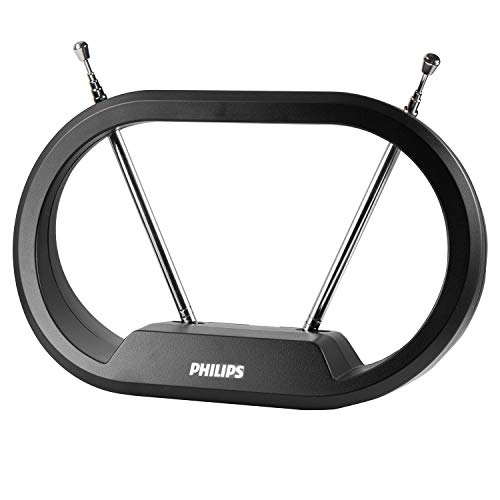
The Philips Indoor TV Antenna Rabbit Ears is an over-the-air broadcast receiver designed to pull in free VHF and UHF network television directly to your living room display. For cord-cutters pairing this accessory with modern 4K OLED, QLED, or LED smart TVs, it unlocks live local programming without requiring cable bills or subscription streaming bundles. Because over-the-air signals arrive uncompressed directly from local broadcast towers, viewers frequently enjoy crisper 1080p resolution, vibrant color accuracy, and reduced broadcast delay compared to heavily compressed internet streams.
This compact indoor antenna is well suited for apartment renters, suburban homeowners, sports fans, and budget-conscious cord-cutters. If you enjoy hosting game-day watch parties, catching local evening news, tracking severe weather alerts, or tuning into prime-time network broadcasts, having reliable over-the-air access provides direct peace of mind. It also works seamlessly for secondary bedroom displays, dorm room setups, or garage TVs where running an extra cable box or relying solely on Wi-Fi bandwidth might be impractical.
Supporting broadcast standards up to 4K and 8K Ultra HD, this unit is built with compatibility for NextGen TV (ATSC 3.0) wherever local transmission towers support the updated standard. The dual dipoles extend and pivot to hone in on VHF channels, while the integrated circular loop focuses on UHF frequency bands. User feedback indicates that picking up native broadcast signals directly to an ATSC-equipped tuner helps maintain clean contrast levels, natural skin tones, and sharp motion handling during fast-paced live sporting events.
Built with a lightweight footprint measuring 6.24 by 7.71 by 2.43 inches and weighing under half a pound, the antenna rests steadily on entertainment consoles, media shelves, or TV stands. The package includes an attached four-foot coaxial cable that screws straight into the standard RF tuner jack on your TV or standalone tuner box. While the classic rabbit ears look blends vintage utility with sleek modern accents, the adjustable elements make directional fine-tuning straightforward when targeting specific local broadcast towers.
Realistic limitations center primarily on physical broadcast physics and indoor placement. With a rated reach of up to 30 miles, homes located in deep rural areas far from regional broadcast towers may experience weaker signal capture or channel dropouts compared to amplified or outdoor roof-mounted antennas. The four-foot coaxial cable also restricts how far away you can position the antenna from your display, which means placing it directly near a high window could require an inexpensive coaxial cable extension.
For viewers looking to trim monthly bills while maintaining crystal-clear access to live sports, award shows, and regional broadcasts, this Philips indoor antenna serves as a practical, plug-and-play addition to any home entertainment system. Pairing it with a modern smart TV lets you effortlessly switch between on-demand streaming apps and zero-latency over-the-air broadcasts. It remains an affordable and dependable choice for city and suburban households seeking authentic broadcast television.
Setting up the Philips Indoor Antenna takes only a few minutes and requires no technical background or special tools. The integrated four-foot coaxial cable threads directly into the antenna input on the back of your television or converter box. Once tightened securely, position the antenna on a flat surface such as your TV stand, shelf, or near a window facing local broadcast towers.
After the physical connection is complete, navigate to your TV settings menu, switch the tuner source to antenna or over-the-air mode, and run an automated channel scan. If certain local channels appear weak, adjusting the angle and length of the telescoping dipoles or rotating the center UHF loop can significantly improve signal stability before rescanning.
Live sports enthusiasts benefit significantly from over-the-air television reception. Unlike streaming platforms that introduce thirty-second to two-minute transmission delays, antenna broadcasts deliver real-time action, preventing live scores and game-winning plays from being spoiled by phone notifications or social media alerts.
Major network sporting events, regional football matchups, and major tournaments broadcast on local affiliates display with exceptional clarity through this antenna. The uncompressed signal preserves sharp motion clarity and natural color gradients on high-refresh-rate 120Hz displays, making fast-moving footballs, hockey pucks, and race cars look smooth and defined.

Pros
- Delivers uncompressed HD and 4K NEXTGEN TV picture clarity without recurring subscription bills
- Wide multi-directional UHF and Hi-VHF reception with reflector minimizes signal dropouts and pixelation
- Included 20-inch pivoting mast allows versatile outdoor, attic, or indoor mounting configurations
- Lifetime antenna warranty provides long-term peace of mind for home entertainment setups
Cons
- Broadcast reception can be degraded by dense tree canopies, hills, and metal roof barriers
- Requires purchasing a separate RG6 coaxial cable since one is not included in the box
- Noticeably larger profile than flat indoor sheet antennas when used inside living areas
The Antennas Direct ClearStream 2V is a high-performance multi-directional over-the-air digital TV antenna designed to integrate directly with modern smart TVs, 4K displays, and full home theater setups. Tailored specifically for cord-cutters, budget-conscious homeowners, sports enthusiasts, and families in suburban or rural zones, this antenna delivers free access to major broadcast networks including ABC, CBS, FOX, NBC, and PBS. Instead of paying hefty monthly subscription fees for compressed cable or streaming channel bundles, viewers can pull in local news, syndicated sitcoms, and primetime entertainment straight over the airwaves with zero recurring costs.
One significant advantage of feeding uncompressed over-the-air broadcasts to your 4K OLED, QLED, or LED television is picture quality. Cable providers and internet live TV streaming platforms heavily compress their signals to save bandwidth, which often leads to macroblocking, artifacting, and dull black levels during fast-action sequences. In contrast, the ClearStream 2V receives pristine, uncompressed digital signals that allow modern TV processors to properly upscale 1080p and 720p feeds. Motion handling remains smooth during high-stakes football matches, Sunday golf tournaments, and holiday parade broadcasts, while dialogue clarity and multi-channel audio route directly to your soundbar or home theater receiver without internet-related buffering or lag.
Engineered with forward-looking entertainment standards in mind, this antenna is fully compatible with NEXTGEN TV (ATSC 3.0), unlocking broadcast resolutions up to 4K UHD and 8K where available. The hardware features patented double-loop UHF elements paired with dedicated Hi-VHF dipoles and a steel mesh reflector panel. That reflector focuses incoming signals while blocking multipath interference bouncing off neighboring buildings or hillsides. Built with weather-resistant materials engineered in the USA, the assembly includes a 20-inch J-mount mast with a pivoting base, giving homeowners the flexibility to install the unit on a roof, chimney, exterior wall, attic rafter, or balcony railing.
Setting up the ClearStream 2V is straightforward whether you are pairing it with a Roku TV, Fire TV, Google TV, Samsung Tizen, or LG webOS display. Once you mount the bracket and connect an RG6 coaxial cable to the antenna input on your television, running an auto-channel scan takes only a couple of minutes. Because the antenna is multi-directional with a wide 70-degree beam angle, precise pinpoint aiming is less critical than with traditional narrow-beam yagi antennas, though aiming the face toward local broadcast towers yields the best signal strength. The included hardware secures tightly to prevent drift during gusty winds, safeguarding stable reception throughout intense storms.
While the ClearStream 2V boasts a generous 60-plus mile reception range, real-world reception is influenced by local topography, heavy tree coverage, and dense building materials such as brick, stucco, or metallic radiant barriers in attics. Users located in deep valleys or beyond 65 miles from transmission towers may require an additional low-noise inline amplifier to maintain reliable signal lock. Additionally, the retail package does not include coaxial cable, meaning buyers must purchase an appropriate length of outdoor-rated RG6 cable separately to complete their living room or home theater installation.
For homeowners and entertainment lovers seeking dependable broadcast access for Super Bowl watch parties, local news updates, and weekend cartoon time, the Antennas Direct ClearStream 2V represents an outstanding long-term investment. It frees up family entertainment budgets while maximizing the crispness, color accuracy, and motion clarity of any modern 4K or 8K television. Backed by a lifetime antenna warranty and reliable American engineering, this antenna is an essential component for any modern cord-cutting home entertainment system.
Installing the ClearStream 2V is flexible thanks to its compact dimensions and multi-surface mounting mast. The included 20-inch J-mount features a pivoting foot that can be secured to vertical surfaces like exterior walls, horizontal planes like flat roofs or balcony decks, or wood rafters inside an attic. Placing the antenna higher off the ground and away from heavy obstructions delivers the strongest signal reception.
To complete the hookup, simply attach standard RG6 coaxial cable from the antenna to the coaxial tuner input on your television. Once connected, open your TV settings menu, select the over-the-air tuner source, and initiate a channel scan. Modern smart TV platforms like Roku, Google TV, and Fire TV automatically detect all available digital channels and populate an integrated on-screen program guide.
Many viewers are surprised to discover that free over-the-air broadcasts often deliver cleaner, more detailed images than paid cable or streaming television. Because network affiliates transmit direct digital signals without the heavy multi-pass compression applied by internet streaming apps, fast camera pans during live sports remain sharp without blur or pixelation. Contrast levels appear punchier and colors pop with greater fidelity on high-end OLED and QLED screens.
Additionally, support for ATSC 3.0 NEXTGEN TV ensures that your home entertainment system is ready for broadcast 4K UHD signals, High Dynamic Range (HDR) color, and enhanced multi-channel audio. Whether you are hosting friends for game day or watching late-night network television in the bedroom, the antenna provides pure uncompressed audiovisual clarity without buffering spinners.
The Reality of 8K Televisions: Hardware, Resolution, and Practical Performance
Consumers exploring the current display market frequently encounter technical debates over whether ultra-high-resolution television sets represent a genuine technological shift or speculative hardware. Premium manufacturers actively engineer and sell true 8K panels equipped with native 7680×4320 grids designed for commercial living rooms. These sets deliver four times the structural pixel count of standard 4K screens and sixteen times that of full high-definition panels. Navigating this category requires examining how hardware engineering, visual physiology, intelligent signal processing, and external source hardware collaborate to create an immersive entertainment experience.
The Engineering Reality: How 8K Television Panels Function
Modern 8K displays achieve their dense image structure by packing over 33 million individual pixels across the physical panel. Because individual subpixels are substantially smaller than those found on comparable 4K screens, the aperture ratio through which backlight illumination passes is naturally reduced. Television engineers overcome this physical constraint by deploying high-density Mini-LED backlight arrays capable of driving ample luminance through the dense liquid crystal grid. These miniaturized diodes allow for precise optical management across thousands of individual illumination zones.
Controlling this dense matrix requires specialized silicon capable of managing both luminance and color transitions simultaneously. On premium models like the Sony 75 Inch 8K Ultra HD TV Z9K Series, dedicated hardware systems like the XR Backlight Master Drive regulate thousands of Mini LEDs with granular precision. This level of local control prevents light bleed from escaping into deep black letterbox bars or dark night skies. Billions of accurate shades are mapped across the screen through wide-spectrum color technologies such as XR Triluminos Pro.
Similarly, displays like the Samsung 85-Inch Class Neo QLED QN990F 8K Mini LED integrate sophisticated optical controllers to handle massive pixel volumes without visual smearing. Processing millions of pixels simultaneously demands dedicated computational power to synchronize color fidelity, backlight timing, and liquid crystal response times. The resulting panel structure produces an image where individual pixel borders remain completely invisible to the viewer. This seamless surface creates an image that resembles printed photographic film rather than an electronic grid.
Human Visual Acuity and the Critical Role of Seating Distance
Evaluating the practical visibility of 8K resolution depends directly on the biological resolving limits of the human eye. Standard healthy human visual acuity operates at roughly one arcminute, which represents one-sixtieth of a single visual degree. When a viewer sits at conventional living room seating distances of nine or ten feet, the human eye cannot easily separate individual pixels on a standard-sized panel. For this biological reason, manufacturers concentrate 8K display manufacturing primarily on massive screen sizes of 75 inches, 85 inches, and larger.
Display size dictates whether the astronomical pixel density delivers a perceptible visual benefit from your primary couch location. While buyers looking at budget-friendly large screen televisions will find standard 4K panels remarkably sharp, stepping closer to an 85-inch display reveals subtle differences in smooth contouring. An 8K panel allows viewers to sit significantly closer to an expansive screen without perceiving scan lines, jagged diagonals, or screen-door artifacts. This visual characteristic enables a wider, cinema-like field of view that immerses peripheral vision without inducing optical fatigue.
Seating geometry also transforms how textural depth is perceived across complex surfaces like ocean waves, architectural stone, and fabric weaves. Even when viewers cannot isolate an individual pixel, the tighter pixel pitch prevents the subtle stair-stepping that sometimes softens curved lines on standard displays. The screen presents curves and fine diagonal vectors with smooth gradients rather than digital aliasing. Consequently, the primary perceptual advantage of an 8K screen at moderate distances is textural smoothness rather than raw perceived sharpness.
AI Upscaling Engines: Bridging the Native Content Gap
The foremost operational challenge facing any 8K display owner is the relative scarcity of native 8K streaming titles, physical discs, and broadcast feeds. Most commercial entertainment remains captured, mastered, and delivered in 4K, 1080p, or standard broadcast 720p resolutions. To prevent lower-resolution media from appearing soft or blurry when stretched across 33 million pixels, flagship televisions depend on advanced neural upscaling engines. Rather than merely duplicating adjacent pixels through basic bicubic interpolation, these processors reconstruct missing spatial detail computationally.
Sophisticated video processors analyze incoming video frames in real time by referencing extensive trained visual databases. In the Samsung 85-Inch Class Neo QLED QN990F, the NQ8 AI Gen3 Processor deploys 768 AI neural networks to analyze texture patterns, facial features, and background elements. The processor reconstructs high-frequency edge detail while simultaneously identifying and filtering out digital noise or compression artifacts. This intelligent interpolation ensures that high-bitrate 4K streaming movies and Blu-ray discs display with crisp clarity that mimics higher-resolution mastering.
Sony achieves similar computational enhancement in the Sony 75 Inch 8K Ultra HD TV Z9K Series through its Cognitive Processor XR. This processing engine evaluates focal points within a frame to emulate the natural way human vision prioritizes foreground subjects over background environments. When processing compressed cable feeds or fast-action sports broadcasts, the engine works to eliminate mosquito noise and macroblocking without introducing harsh ringing halos around high-contrast edges. The resulting picture maintains natural texture across skin tones, landscapes, and complex clothing patterns.
Next-Gen Broadcasting and Over-the-Air ATSC 3.0 Integration
While internet streaming providers slowly expand their high-resolution libraries, over-the-air digital broadcasting has made major technical strides through ATSC 3.0 NextGen TV. This upgraded broadcast standard supports enhanced data pipelines capable of delivering 4K high dynamic range signals and provides the structural framework for future 8K transmission standards. Viewers can receive these free terrestrial network broadcasts directly using dedicated digital antennas without paying recurring cable or satellite subscription fees. Uncompressed broadcast signals frequently provide higher visual fidelity than heavily compressed streaming streams.
Connecting high-performance TV antennas to an 8K display equipped with an ATSC 3.0 tuner ensures access to pristine broadcast feeds. Hardware like the Antennas Direct ClearStream 4V Outdoor TV Antenna provides multi-directional UHF and Hi-VHF elements designed to capture signals from distant transmission towers. Its integrated signal reflectors help protect incoming broadcast streams from atmospheric interference and physical reflections that cause pixelation. Feeding clean broadcast feeds into an 8K panel gives internal AI upscalers superior source material for real-time frame reconstruction.
For compact or suburban setups, versatile equipment such as the Antennas Direct ClearStream 2V Indoor Outdoor TV or simple dipoles like the Philips Indoor TV Antenna Rabbit Ears for Local channels support NextGen TV frequencies. These antenna options capture uncompressed network sports, local news, and syndicated programming straight from the airwaves. Because terrestrial signals bypass the aggressive compression algorithms common to third-party internet streaming apps, fast-moving sporting events retain sharper edge definitions. The display processor can then upscale that uncompressed signal with fewer unwanted motion artifacts.
HDMI 2.1 Bandwidth and High-End Gaming Capabilities
Connecting external video hardware to an 8K display demands substantial interface bandwidth that exceeds older connection standards. HDMI 2.1 architecture is mandatory for transmitting full 8K video at 60Hz or high-framerate 4K video at 120Hz and beyond. Fixed Rate Link (FRL) technology across modern HDMI 2.1 ports delivers up to 48Gbps of uncompressed data transmission. This expanded transmission pipe accommodates 10-bit and 12-bit color depths alongside uncompressed HDR dynamic metadata and multichannel object-based audio.
Modern gaming enthusiasts benefit directly from these high-bandwidth inputs when connecting high-performance graphics cards and current-generation gaming consoles. The Samsung 85-Inch Class Neo QLED QN990F pushes gaming responsiveness forward by supporting variable refresh rate speeds up to 4K at 240Hz. High refresh rates virtually eliminate screen tearing and input latency during fast-paced competitive gameplay. Dedicated gaming dashboards allow players to monitor real-time frame rates, toggle dynamic black equalizers, and optimize input lag settings without interrupting their gaming sessions.
Console integration is equally refined on flagships like the Sony 75 Inch 8K Ultra HD TV Z9K Series, which includes exclusive features designed for the PlayStation 5. Functions such as Auto HDR Tone Mapping calibrate high dynamic range parameters automatically during initial setup to preserve highlight detail in bright skies and dark corners. Auto Genre Picture Switch toggles the television between Game Mode for ultra-low latency and Standard Mode for media playback. With low input lag under ten milliseconds, these massive displays provide responsive control for gaming enthusiasts.
Panel Brightness, Local Dimming, and Glare Management
Achieving realistic dynamic range on an 8K panel requires exceptional peak brightness to balance out the dense subpixel structure. Mini-LED backlighting technology uses thousands of tiny diodes grouped into hundreds or thousands of independently controlled local dimming zones. This dense grouping allows the television to drive dazzling specular highlights in metallic surfaces, direct sunlight, and explosions while keeping neighboring letterbox bars deep and ink-black. Precise dimming algorithms suppress unwanted haloing or blooming artifacts around high-contrast elements such as subtitles.
Room lighting environments present a distinct challenge for home theater installations, especially in living rooms surrounded by wide windows. High-end 8K panels combat daytime glare through specialized optical filters embedded directly into the outer panel surface. Technologies like Samsung Glare Free engineering diffuse incoming ambient light across the panel surface, preventing mirror-like reflections from washing out darker scene content. This optical treatment maintains high perceived contrast even during bright daytime viewing without needing blackout curtains.
Color fidelity across wide viewing angles is another critical component of premium 8K television engineering. Optical wide-angle layers ensure that off-axis viewers seated along the side of the room enjoy consistent color saturation and contrast levels. Quantum dot enhancement films, such as those found on Neo QLED models, produce vibrant primary colors that cover broad cinema spectrum standards. When paired with dynamic tone mapping standards like Dolby Vision or HDR10+, the television preserves creator intent across both intensely bright highlights and subtle shadow transitions.
Practical Consumer Trade-Offs: Power, Heat, and Long-Term Value
While the visual engineering behind 8K displays is undeniable, ownership introduces unique physical and operational considerations. Driving 33 million pixels with high-output Mini-LED backlights generates more thermal energy and requires more electrical wattage than standard 4K panels. International energy efficiency standards, including European Union Ecodesign regulations, have established strict power limits for large consumer screens. To comply with these directives, modern 8K televisions rely on intelligent ambient light sensors and default power-saving profiles that regulate sustained full-screen brightness.
Physical handling and wall-mount installation also require careful structural planning due to the substantial weight of large-chassis panels. An 85-inch television chassis demands heavy-duty VESA mounting brackets and secure dual-stud wall anchoring to ensure structural safety. Proper rear ventilation clearance is equally vital to allow heat sinks to dissipate operating warmth quietly without obstructing internal air channels. Cable management solutions like Samsung Wireless One Connect help reduce physical clutter by transmitting audio and video wirelessly from external connection hubs.
Determining whether to invest in an 8K display ultimately hinges on your screen size goals, room dimensions, and hardware upgrade cycle. Buyers purchasing displays under 75 inches are generally better served by flagship 4K OLED or Mini-LED models that maximize native contrast at lower price tiers. However, for expansive home theaters accommodating screens 75 inches and larger, 8K panels provide unmatched pixel invisibility and state-of-the-art AI processing. Investing in an 8K flagship provides an ultra-wide visual canvas built to handle upcoming video standards for years to come.
The existence of commercial 8K televisions is an established reality supported by premium engineering from leading display manufacturers. While native content remains in development, advanced neural upscaling processors and dense Mini-LED backlights ensure that contemporary 4K and broadcast media look remarkably crisp on extra-large displays. By balancing viewing distances, room lighting conditions, and interface bandwidth needs, home theater enthusiasts can decide whether an 8K display represents the right centerpiece for their entertainment space.


Write Your Review
No reviews yet. Be the first to share your experience!